

E.1-18: How the Holy Spirit Turns Fragmentation into Harmony
Season 1: Episode 18
How the Holy Spirit Turns Fragmentation into Harmony
listen by clicking the audio player here:
In this episode you will learn:
In this episode of The Christian Jung Podcast, the anima and animus rise from the descent into the radiance of integration. Through Jungian psychology, Christian mysticism, and the movements of Sophia and Logos, we explore what happens when the Holy Spirit becomes the rhythm within us.
We talk about:
🌿 The moment when love becomes wisdom, and wisdom becomes love
🧠 How Eros and Logos — intuition and clarity — find harmony through the Spirit
💬 Why insight doesn’t come through striving but through surrender
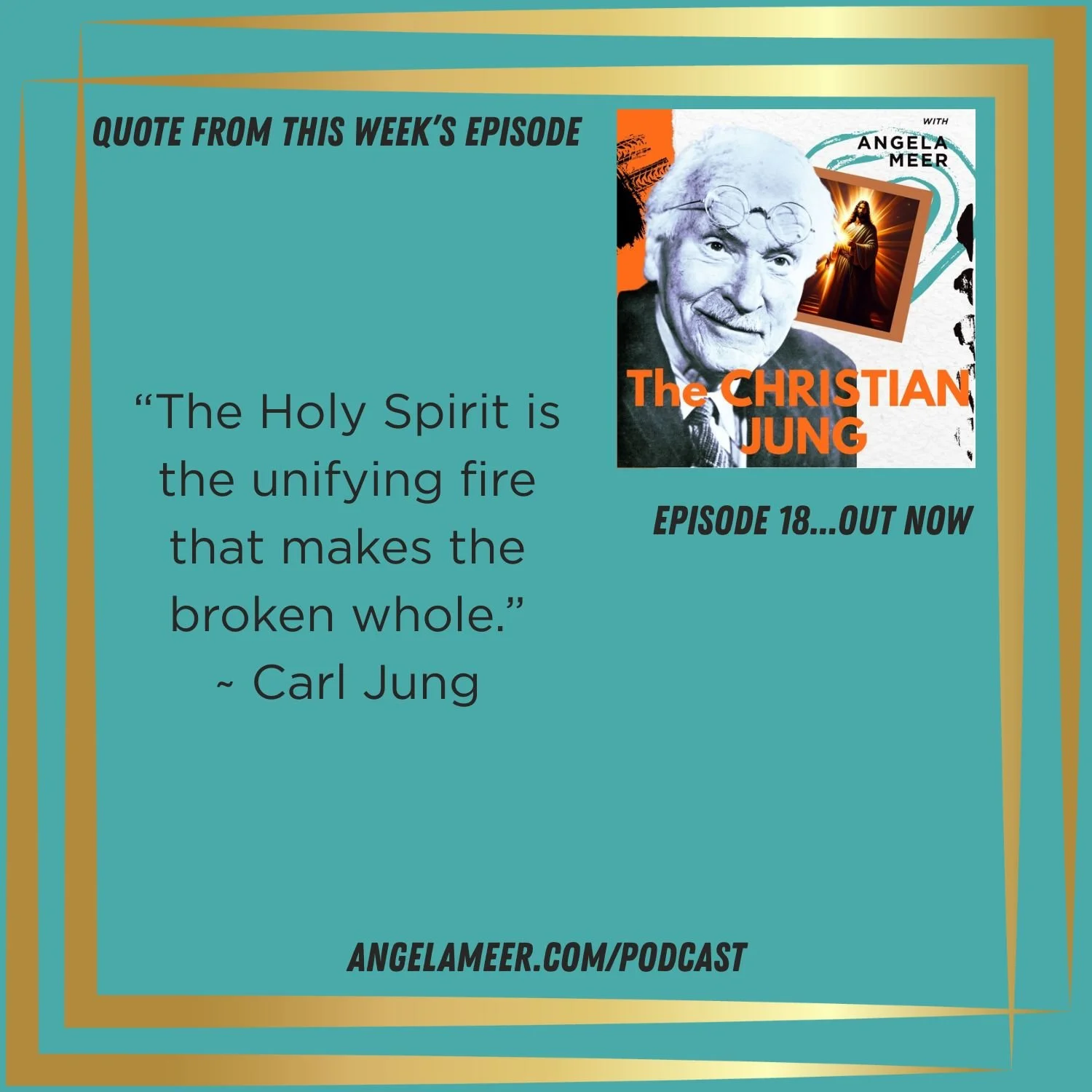
✝️ How the Holy Spirit acts as “the unifying fire that makes the broken whole”
If you’re longing to live from your center — not balancing, not fixing, but resting in harmony — this episode is an invitation into inner resurrection.
Angela Meer takes us into the dawn of the soul — where the shadow has been surrendered and the Spirit begins to breathe new life.
Episode Length: 16:00
can’t get enough? sign up for free 5-day email series here

Transcript
After the long winter of the soul,
the garden begins to stir.
Roots press upward through the dark earth,
and what was hidden becomes green again.This is the mystery of divine balance—
the awakening of Wisdom and the renewal of Word.
Sophia breathes, Logos responds,
and creation begins again inside us.In that still garden of the heart,
God is teaching us how to love in rhythm—
to think with tenderness and to feel with truth.It’s time to awaken holy wonder. Stay with me.
illumination by the holy spirit
We are on the8th episode on a ten episode arc about anima and animus. You are invited to go back to episode 11to get the full picture of what we are exploring today.
After every descent comes the dawn.
The soul that has passed through the fire of transformation
rises clothed in light it did not possess before.
The shadow that once frightened now becomes ground for radiance.
The wound that once bled now shines with wisdom.In Jung’s language, this is the moment of illumination—
the alchemical stage when the purified opposites within the psyche,
anima and animus, eros and logos,
begin to move in harmony.
The tension of the divided self no longer burns;
it glows.“The light shines in the darkness,
and the darkness has not overcome it.” — John 1:5The soul becomes a mirror for divine integration—
where eros, the movement of love and relation,
and logos, the movement of truth and order,
finally recognize one another.In Christian mysticism, this is the inner image of Christ—
the Word through whom all things were made,
and the Wisdom who danced beside God at creation.“I was beside Him, like a master worker,
and I was daily His delight.” — Proverbs 8:30These two currents—Eros and Logos—are not rivals,
but partners in the divine life.
Eros draws all things into communion;
Logos gives that communion form and meaning.
Together they reveal the pattern of wholeness,
the teleios life in which all opposites are reconciled.When Eros has been purified of attachment,
it becomes compassion that does not grasp.
When Logos has been healed of rigidity,
it becomes clarity that does not wound.
And when the soul learns to hold them both,
it reflects the radiance of Christ Himself—
love that thinks, and truth that feels.In this resurrection stage,
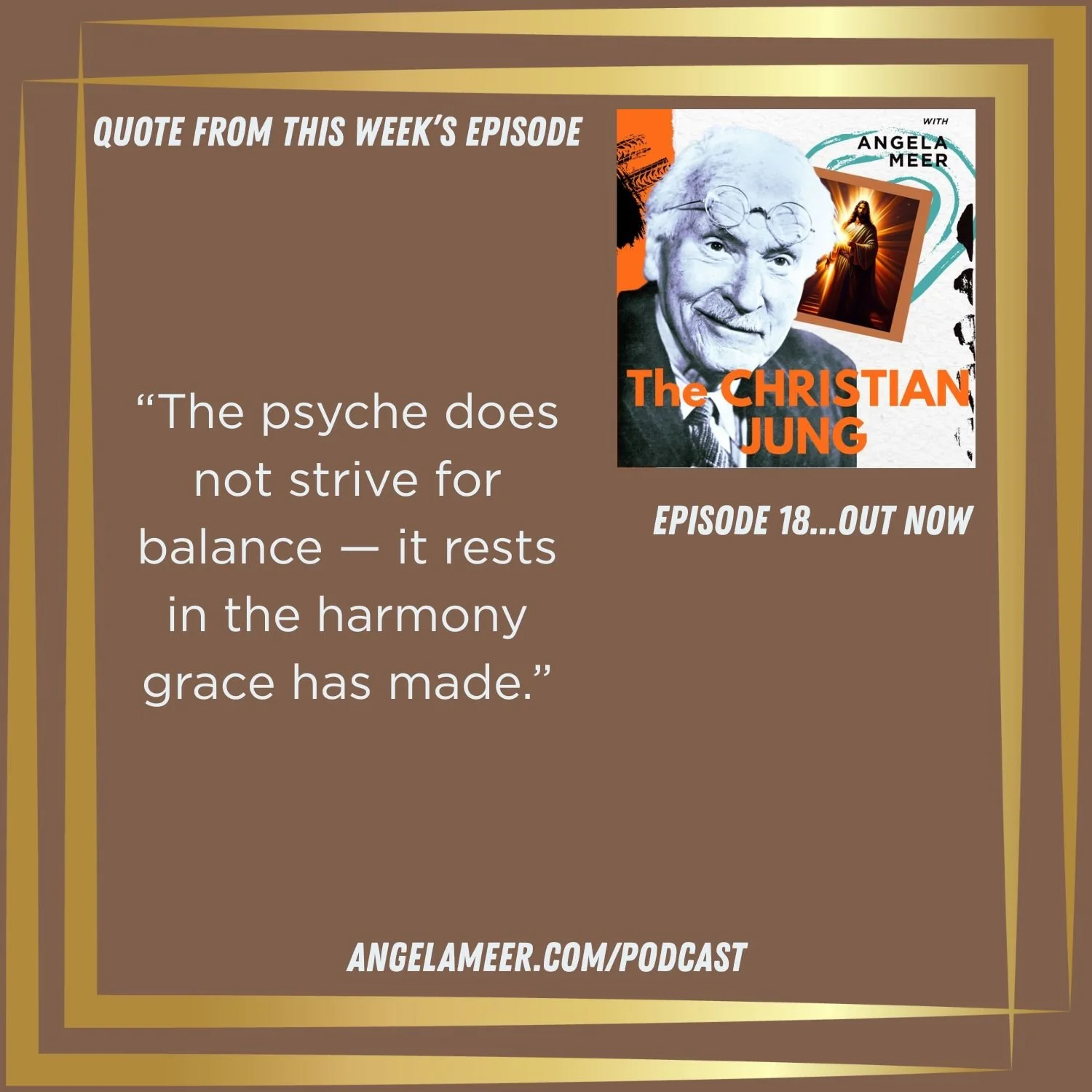
the psyche no longer strives to balance opposites through willpower.
It rests in the harmony already established by grace.
The anima and the animus
now move together as a single breath of divine reciprocity.This is the inner resurrection:
when love becomes wisdom,
and wisdom becomes love.When the inner opposites begin to move together—
eros reaching out in love, logos shaping that love with meaning—
a third presence awakens between them:
the Holy Spirit, who gives rhythm to the dance.Jung spoke of the anima mundi, the soul of the world,
as the mediating life between matter and spirit (Aion, §229).
For the Christian, that mediating life is no abstraction—
it is the Spirit of God who hovered over the waters at creation,
and who now hovers over the waters of the human heart.“And the Spirit of God was moving over the face of the deep.” — Genesis 1:2
The Spirit is the breath that animates the Word,
the warmth that makes Wisdom fruitful.
Where logos clarifies, the Spirit inspires;
where eros longs, the Spirit sanctifies that longing into love.
Through the Spirit, Sophia becomes luminous,
and the Word becomes flesh.Angela (continuing):
The saints, the mystics and the early church fathers have always known this.
They felt the Spirit not as doctrine but as presence—
the living current flowing between knowing and feeling,
truth and tenderness, heaven and earth.In our own psyche, that same movement continues.
The animus carries the impulse toward clarity,
the anima toward communion;
but it is the Holy Spirit who keeps them from collapsing into pride or sentiment.
The Spirit breathes balance into the soul—
giving logos compassion and giving eros form.“The wisdom from above is pure, peaceable, gentle, full of mercy.” — James 3:17
This is the Spirit’s signature: peace, mercy, integration.
the slow transfiguration of human consciousness
until it mirrors the harmony of Christ Himself.To live in the Spirit is to let that divine rhythm lead the dance.
We do not force understanding; we receive it.
We do not cling to emotion; we offer it.
Mind and heart breathe as one—
Word, Wisdom, and Spirit moving together in us.
the arrival of transformed intimacy
Welcome back.
When the Holy Spirit begins to move within us,
the world itself becomes alive with meaning.
What once felt random becomes revelation.
The patterns of our lives, our symbols, our dreams —
all begin to shimmer with divine conversation.
This is the language of integration —
the place where eros and logos,
longing and understanding,
are gathered into one current by the Spirit’s breath.
Jung knew this movement well.
After years of intellectual striving and inner crisis,
he came to see that the psyche is not merely a structure of instincts,
but a living vessel of divine participation.
In Memories, Dreams, Reflections,
he spoke of encountering what he called the spirit of the depths —
a force that “penetrates everything” and speaks in symbols.
It was a discovery that the human soul is porous to God.
And later, in Psychology and Religion (CW 11, §260),
Jung would write these luminous words:
“The Holy Spirit is a living symbol of the union of opposites —
a unifying fire which transcends all contradictions
and makes the broken whole.”
That sentence carries the quiet thunder of revelation.
Jung had spent his life studying symbols of reconciliation,
but here he names their source:
the Holy Spirit, the unifying fire.
It is the Spirit who moves between heaven and earth,
between conscious and unconscious,
between eros and logos —
the breath that turns chaos into cosmos,
the warmth that makes wisdom bloom.
The Holy Spirit is not an idea or abstraction.
She is movement —
the very rhythm through which the soul learns to see.
Where the Word speaks, the Spirit interprets.
Where Wisdom perceives, the Spirit animates.
Where opposites fracture, the Spirit fuses them into wholeness.
When I read Jung’s words, I think of Pentecost —
the tongues of fire that did not destroy,
but illumined.
The same fire that descended on the disciples
descends upon us —
through insight, forgiveness, creativity,
through the warmth of divine presence within. — 1 Corinthians 2:10
“The Spirit searches all things, even the deep things of God.”
the Holy Spirit,
is also the artist of the soul —
gathering all our fragments,
all our half-loves and unfinished prayers,
and kindling them into one steady flame.
Personal Story:
When the Holy Spirit begins to teach the soul to see,
understanding no longer comes by effort.
It comes by breath.
Insight unfolds like dawn breaking through mist —
not as something achieved, but received.
In Jung’s language, this is the stage of illumination.
In Christian language, it is life in the Spirit —
the mind and the heart learning to breathe together.
The anima and the animus, the movements of eros and logos,
no longer compete for control.
They rest in their source,
the Spirit who holds them both in love.
A Personal Reflection
In my own life, I’ve learned that this movement often begins in stillness.
Many of my most vivid insights have not come while striving to create,
but in the quiet afterward —
in prayer, or long walks, or the wordless silence before writing begins.
There are moments when I sense the Spirit moving through image and symbol,
weaving theology and psychology into something living.
It feels like being written rather than writing.
What begins as thought becomes communion.
There was a season when I felt uncertain —
about my work, my calling, the language I used to hold faith and soul together.
Yet God teaches us to wait upon Him. In those moments, I say yes to the invitation to let Him grown down deeper within me. To let Him soften my edges and blur the lines distinguishing him from me. We need these times of private silence where the ache of not knowing the next steps turns into the spontaneity of a dance where we can develop our sense of Him without the need to make it about us.
In those silences I hear the same invitation Jung described:
to trust the inner rhythm of the Spirit more than my own design.
The more I listened, the more I saw that revelation is relational.
The Spirit does not simply inform; Holy Spirit transforms.
She takes what is merely intellectual and makes it incarnational.
takes what is emotional and gives it meaning.
She turns the tension of opposites into music.
Perhaps you’ve felt that too —
a moment when clarity descended like a breath,
when your own striving ceased
and something larger began to speak through you.
That is the Spirit’s artistry —
the unifying fire that makes the broken whole,
the breath that fills every fragment with new life.
.” — Zechariah 4:6 “Not by might, nor by power,
but by My Spirit, says the Lord of hosts
To live this way is to let the Holy Spirit choreograph your becoming —
to allow love and wisdom, Word and silence,
to find their rhythm within you.
This is the resurrection life of the soul:
no longer divided,
but alive with the music of God.
Call to Action:
“In the Christian Jung community, I go deeper into how I actually applied this in real time — and what happened next. You are given all the tools you need to learn to what is awakening within you and to inspire your Christian faith into the realm of Spirit. Go to AngelaMeer.com to join us.
finding the transformed bride
As we close today’s episode,
I invite you to take a few quiet moments with the Holy Spirit.
Not to analyze, but to listen.
Ask yourself:
When have I felt the nearness of the Spirit—perhaps as warmth, insight, or quiet conviction?
Has there been a time when the Spirit interrupted my plans with gentleness and new direction?
Where in my life is the Spirit inviting me to breathe again—to forgive, to create, to rest?
How might the Spirit be uniting parts of me I once thought could never belong together?
Let these questions become prayer.
The Spirit is not far off;
She is as close as your own breath,
hovering, healing, gathering what was scattered.
In The Christian Jung Community,
we go deeper into these practices —
not as mere study,
but as the living rhythm of transformation.
Together, we explore the ways
the Spirit unites psychology and prophecy, symbol and Scripture,
guiding us toward spiritual and psychological wholeness.
Membership opens only a few times each year,
so if you’d like to continue this contemplative journey,
visit AngelaMeer.com to sign up for updates.
You’ll find guided meditations, reflective discussions,
and creative exercises that nurture your soul’s unfolding.
Next week, we continue the Anima–Animus arc
with Episode 9 — “Sophia Rising: The Wisdom That Remembers.”
We’ll explore the mystery of holy memory —
how the Spirit brings to mind the divine patterns
we once knew before time,
and how Wisdom reawakens in the midst of ordinary life.
Join me next week
as we listen for the voice of Sophia
calling the soul back to its sacred remembering.
reflect and pray
Now, take a few moments of silence.
Let that breath of holiness fill you.
Let every thought, every desire,
be gathered into that one sacred rhythm —
the Spirit’s unifying fire
that transcends all contradictions
and makes the broken whole.
Let’s close with the words of St. Augustine,
who understood that the Spirit’s fire
is not destruction, but illumination.
Breathe in me, O Holy Spirit,
that my thoughts may all be holy.
Act in me, O Holy Spirit,
that my work, too, may be holy.
Draw my heart, O Holy Spirit,
that I may love only what is holy.
Strengthen me, O Holy Spirit,
that I may defend all that is holy.
Guard me, O Holy Spirit,
that I may always be holy.