

E.2-11: God Speaks in Dreams
Season 2: Episode 10
God speaks in dreams
listen by clicking the audio player here:
In this episode you will learn:
God has been speaking to you in your dreams. He has not been silent.
In this episode you will learn:
Dreams are not a fringe category -- they are woven into the central narrative movements of Scripture
The church's dismissal of dreams is historically recent and culturally specific, not biblically grounded
You were right to wonder -- and this arc is the permission you have been waiting for
Episode Length: 17:00
can’t get enough? sign up for free 5-day email series here

Transcript
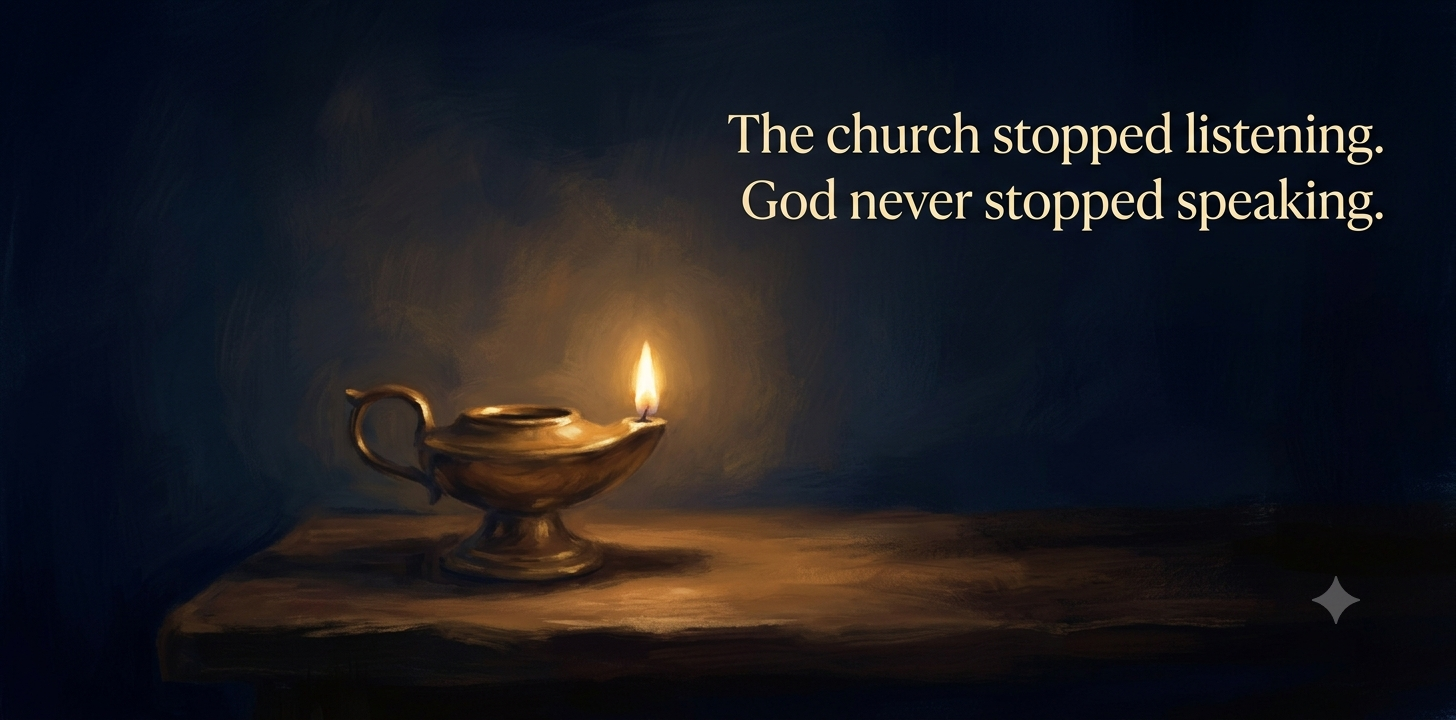
The church made a quiet decision that God never agreed to. No council, no creed, no formal declaration -- just a slow drift away from something Scripture takes entirely for granted: that God speaks to sleeping people, and the ones who pay attention change the course of nations. You were probably taught that dreams are not a reliable category of spiritual experience. Too subjective. Too easily manipulated. Better to stay in Scripture, stay in prayer, stay in the verifiable. And yet the Scripture you were told to stay in is saturated with dreams. Genesis to Revelation, God speaks in the night, and the narrative turns on whether anyone is paying attention. This series does not ask you to abandon discernment. It asks you to apply your discernment to something the Bible never stopped taking seriously -- and the church quietly decided to leave behind.
INTRO -- after music]
I'm Angela Meer, and I welcome you into the sacred meeting place of psychology and theology, where the timeless patterns of Scripture meet the deep symbols of the soul.
Today we begin a new arc -- ten weeks on dreams. And I want to name what some of you are already feeling, because I know this audience. Some of you heard 'ten weeks on dreams' and felt a little uncomfortable. Dreams feel like uncertain territory for serious Christians. Too charismatic. Too subjective. Too close to the kind of spiritual experience that can be manufactured or manipulated. I understand that hesitation. But I want to ask you to stay with me today, because what I am going to show you is not a departure from the biblical text. It is a return to it. The Bible you trust is full of dreams. The dismissal of dreams is not a biblical position. And the next ten weeks are going to take you somewhere the text was always pointing.
It's time to awaken holy wonder.
I want to start personally today, because my relationship with dreams is a little different from the story most people tell about coming to take dreams seriously.
I always knew that God spoke in dreams. Not because someone sat me down and taught me carefully and I came to the position through study. The knowing was just there, underneath whatever polite skepticism my Christian context occasionally performed. When the Charismatic tradition and the Catholic Charismatic Renewal gave me language and a framework for understanding dreams and their interpretation, I did not feel like I was learning something new. I felt like I was finally being given words for something I had already recognized.
Maybe you are like me. Maybe you quietly nodded along when your Christian tradition laughed at the idea of God speaking through dreams -- too charismatic, too subjective, not necessary for serious Christian work. Maybe you sat in services where someone joked about 'pizza dreams' and you smiled along while something in you quietly disagreed. Because deep down you knew. You knew that the same Bible you were taught to trust used dreams to save the child Jesus in his early years, through a father who obeyed in the night what God spoke while he slept. You knew that kings were brought to their knees seeking interpretation from those who walked with God. You knew that the story of Israel does not reach the Exodus without Joseph's dreams. You kept that knowing quietly, and perhaps felt a little embarrassed by it. This arc is the permission you have been waiting for. Not permission from me. Permission from the text that was always there.
[DEFINE THE CONCEPT -- 3:00-8:00]
Let me define what we mean by a biblical dream before we go any further, because there are distinctions worth making.
In Scripture, the dream is understood as one of the channels through which God speaks to human beings -- not the only channel, not always the primary one, but a real and recurring one. Numbers 12:6 is as clear as it gets on this: God says, if there is a prophet among you, I the Lord make myself known to him in a vision; I speak with him in a dream. God's own description of how prophetic communication works. The dream is not incidental to the prophetic channel. It is one of its primary forms.
The biblical dream is not the same as every dream. The tradition has always recognized that not every night vision carries divine weight -- some dreams arise from the body, some from the ordinary processing of the mind. But the tradition's response to that complexity was not to dismiss all dreams. It was to develop discernment. And that discernment assumed the dream was real enough to be worth discerning carefully. We will spend a full week later in this arc on discernment specifically. For now, what matters is establishing that the category is legitimate -- that the serious Christian has biblical ground to stand on when they take their dreams seriously.
[REAL JUNG -- 8:00-15:00]
Carl Jung spent fifty years working with the dreams of his patients. He kept his own dream journal for decades. And one of his most striking observations was not clinical -- it was historical.
He noted that modern Western culture, and in particular Protestant Christianity, is one of the only civilizations in recorded human history to treat the dream as meaningless. Think about what that means. The Egyptians built entire temple complexes -- the Serapeum, the temples of Asclepius adopted later by the Greeks -- specifically for the practice of dream incubation: sleeping in a sacred space with the intention of receiving divine communication through a dream. The Hebrew scriptures are saturated with dreams as a primary form of divine speech. The Greek world sent their sick to sleep in the temples of Asclepius, believing that the god would speak healing to them in the night. The Roman world, the Chinese world, the indigenous world across every continent -- every major human civilization treated the dream as a genuine source of meaning, guidance, and contact with the sacred.
And then came the Enlightenment. And the church absorbed the Enlightenment's epistemology more thoroughly than it realized. Rational, verifiable, empirical -- these became the categories of serious knowledge. Anything interior, subjective, or immeasurable was gradually moved to the margins. Jung did not see this as progress. He saw it as impoverishment. A civilization that has closed off its access to the unconscious -- to the inner life, to the dream, to the symbol -- is a civilization that has lost contact with the deeper layers of its own soul.
For the Christian, the restoration Jung was calling for is not Jungian at all. It is a return to the biblical normal. The church had it. The early church fathers had sophisticated theologies of dream discernment. The Desert Fathers practiced attentive reception of dreams within a careful framework of watchfulness. Jerome's intellectual life was shaped by a dream. And then, slowly, the culture shifted, and the church followed the culture rather than the text. We are going back to the text.
[SCRIPTURE -- 15:00-25:00]
Let me walk you through the Scripture I need you to hear today, because the density of dream material in the biblical record is the whole case.
Genesis 28:10-17: Jacob is traveling, alone, and stops for the night. He takes a stone for a pillow and sleeps. And in the dream, he sees a ladder set up on the earth, with its top reaching to heaven, and the angels of God ascending and descending on it. And God speaks. I am the Lord, the God of Abraham your father and the God of Isaac. The land on which you lie I will give to you and to your offspring. This is not a minor moment. This is the renewal of the Abrahamic covenant. And it happens in a dream, at an undistinguished rest stop, while a man sleeps with a rock under his head.
Genesis 37:5-11: Joseph has two dreams. In the first, his brothers' sheaves bow down to his. In the second, the sun and moon and eleven stars bow down to him. His brothers hate him for it. His father rebukes him. And then the text says -- quietly, almost as an aside -- but his father kept the saying in mind. The narrative that leads to Israel's survival in Egypt, to Moses, to the Exodus, to the formation of the people of God -- it begins here. In a teenager's dreams that his family dismissed and his father quietly held.
Matthew 1 and 2: Joseph the carpenter receives four dreams. Do not fear to take Mary as your wife -- for that which is conceived in her is from the Holy Spirit (1:20). Rise, take the child and his mother, and flee to Egypt (2:13). Rise, take the child and his mother, and go to the land of Israel, for those who sought the child's life are dead (2:20). The Magi are warned in a dream and depart by another route (2:12). Count the obediences. Count the consequences of each one. The infancy of Jesus is held together by dream obedience. This is not the fringe of the Gospel. This is the spine of the infancy narrative.
Joel 2:28, quoted by Peter on the day of Pentecost: And it shall come to pass afterward, that I will pour out my Spirit on all flesh; your sons and your daughters shall prophesy, your old men shall dream dreams, and your young men shall see visions. Peter quotes this not as a description of something that happened in the past. He quotes it as evidence that what the crowd is witnessing -- the outpouring of the Spirit at Pentecost -- is the fulfillment of Joel's prophecy. The dream is named as a sign of the Spirit. Not a relic. A sign.
[MID-EPISODE
If this episode is opening something that has been quietly closed for a while, I want to invite you to come deeper. Go to Substack and search for The Christian Jung. The full written article is there, with more of the biblical and historical material we have covered today. And the Inner Room companion this week goes into the early church's theology of dreams -- the Desert Fathers, Tertullian, Jerome -- and introduces three practices for beginning to receive your own dreams tonight. One of them you can start before you go to sleep this evening.
[THREE TEACHING POINTS -- 25:00-35:00]
Three things I want you to carry from this episode:
The first: dreams are woven into the central narrative movements of Scripture.
This is not a fringe category. This is not the charismatic fringe or the mystic outlier. The covenant at Bethel happens in a dream. The survival of Israel in Egypt begins with dreams. The protection of Jesus in his infancy depends on dream obedience. Joel names the dream as a sign of the Spirit's outpouring. You cannot remove the dreams from the biblical record without tearing out the spine of the narrative. The category is legitimate. It was always legitimate.
The second: the church's dismissal of dreams is historically recent and culturally specific.
It is not ancient Christianity. The early church fathers took dreams seriously and built theologies for discerning them. The Desert Fathers received dreams attentively within a careful framework of watchfulness. The dismissal came with the Enlightenment, and the church absorbed it without fully noticing. You are not recovering something exotic. You are recovering something the church once knew and then forgot because the culture told it to.
The third: you were right to wonder.
If you have been carrying a quiet knowing that your dreams mattered, and you have been performing skepticism because your tradition expected it -- you can put that performance down. The text supports the knowing. The history supports the knowing. The tradition, properly understood, supports the knowing. The next nine weeks are going to give you the theology, the framework, and the practice to receive what has been coming for you all along.
[RECAP]
The church made a quiet decision that God never agreed to. But the biblical record is unchanged. Dreams are woven into its central narratives. The dismissal is recent and cultural, not ancient and biblical. And you were right to wonder. This arc is the beginning of the recovery.
[PAUSE PRAY HEAL]
Let's close with a moment to Pause, Pray, and Heal. Take a breath. If something in today's episode has opened a door that has been closed for a while, let it stay open.
[Pause]
A prayer drawn from the tradition of the Desert Fathers, who prayed this before sleep:
Lord, as I give my body to sleep, keep watch over what my body cannot guard. Speak in the night if you will. And give me ears that are willing to hear what the waking hours too often close against you.
And before you sleep tonight: put a notebook beside your bed. Write one sentence at the top: I am paying attention now. The practice begins with the posture.
FINAL
Subscribe to The Christian Jung Podcast wherever you listen and share this episode with someone who has been quietly wondering about their own dreams. Find me at angelameer.com or on Substack as The Christian Jung. Nine more weeks. We are just getting started.
Heal Deeply. Walk Holy.
[END]