

E.2-4: What Your Art, Dreams, and Imagination Reveal About the Shadow
Season 2: Episode 14
What Your Art, Dreams, and Imagination Reveal About the Shadow
listen by clicking the audio player here:
In this episode you will learn:
There is a scene from a film that has stayed with you for years. A recurring dream you stopped writing down. A painting, a song, a line from a novel that landed too hard the first time you encountered it and has been quietly waiting in the back of you ever since.
You were taught these were distractions. You were taught the imagination was suspect.
In this episode of The Christian Jung Podcast, Angela Meer argues that your soul has been speaking to you for years, and that Scripture has always known this. Half of the Bible is given in image, dream, vision, and parable. Joseph received the throne of Egypt through dreams (Genesis 41). Daniel received the architecture of empire through visions (Daniel 7). Joel prophesied that the Spirit at Pentecost would come with dreams and visions, and Peter quoted that promise on the first day of the Church (Joel 2:28; Acts 2:17). Jesus refused to teach in proposition: “He did not say anything to them without using a parable” (Mark 4:34).
Angela walks through the Christian imagination as something older than Jung by fifteen centuries: the Desert Fathers’ nepsis (watchfulness of the heart), Ignatian imaginative contemplation, Hildegard of Bingen’s visionary fidelity, and the careful Christian adaptation of what Carl Jung called active imagination. She names the resistance most orthodox Christians feel about this language, and she answers it from Scripture. She also shares her own ongoing practice of illustrated dream journaling and explains, with specific recent dream images, why she draws her dreams instead of writing them.
This is week four of the shadow arc, inside the larger work of The Christian Jung, a systematic theology of psychological wholeness for serious Christians whose orthodoxy is intact but whose inner life still needs healing.
If you have ever wondered what to do with the images that have stayed with you for years, this episode is for you.
Find this week’s free article on Substack at The Christian Jung. The Inner Room companion article teaches three Christian practices for learning to listen, in depth. Subscribe at The Christian Jung on Substack, or visit angelameer.com.
Heal Deeply. Walk Holy.
Episode Length: 18:00
can’t get enough? sign up for free 5-day email series here

Transcript
There is a scene from a film that has stayed with you for years. You cannot explain why. There is a recurring dream you stopped writing down because you got tired of trying to make it mean something. There is a painting, a song, a line from a novel that landed too hard the first time you encountered it and has been quietly waiting in the back of you ever since. You were taught that these were distractions. You were taught the imagination was suspect. So you stopped listening.
I want to suggest, carefully, that your soul has been speaking to you for years. And that the silence you have been keeping with it is not faithfulness. It is starvation.
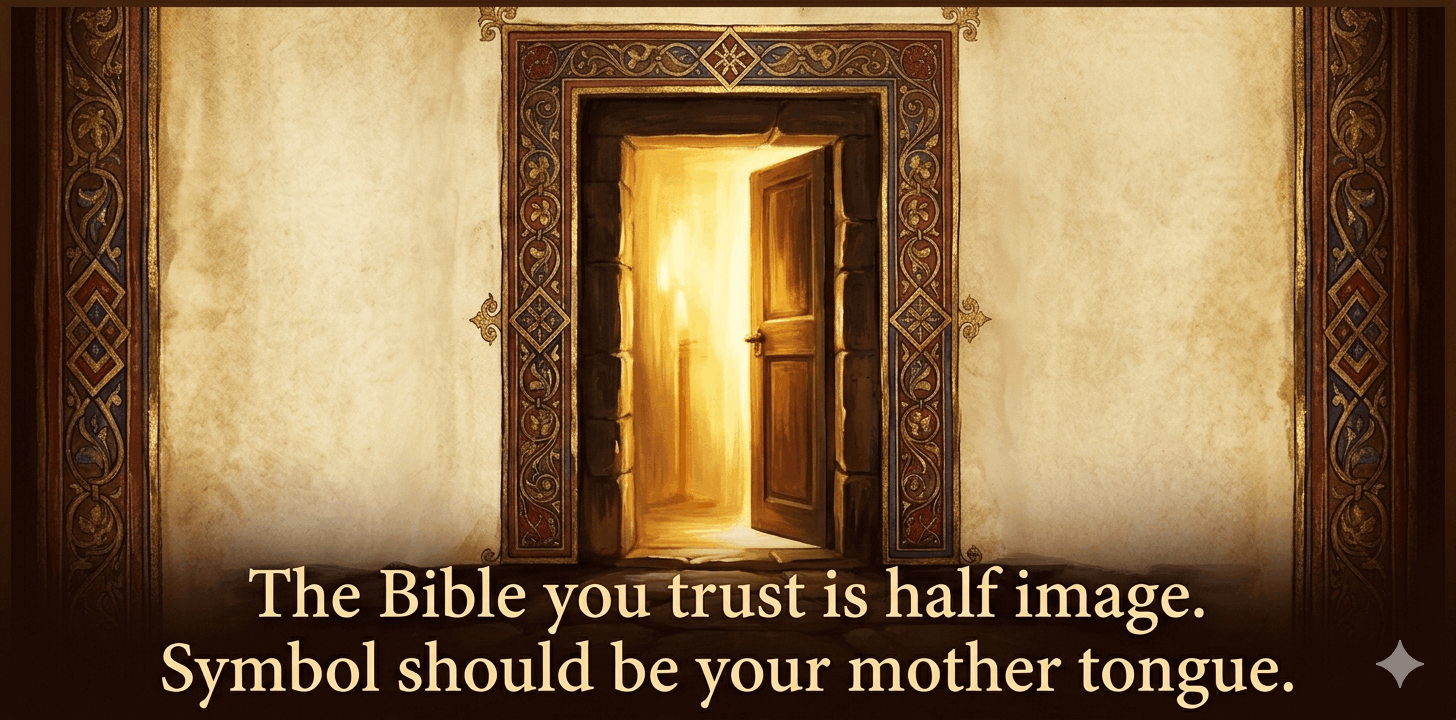
I know the moment you read the word imagination in a Christian context, half of you tightens. You associate it with New Age territory, with people who claim God told them things He did not say, with the whole broad shipwreck of evangelical mysticism gone unsupervised. That instinct is not wrong. It is incomplete. The Bible you trust is itself profoundly imagistic. It is given half in proposition and half in image, and most of us have spent our whole lives only learning to read the propositions.
Where We Are in the Journey
We are in week four of the shadow arc, inside the larger work of The Christian Jung, which is a systematic theology of psychological wholeness for serious Christians whose orthodoxy is intact but whose inner life still needs healing. The previous weeks named what lives below the surface of sincere faith, traced how patterns form and persist, and asked why good Christians become strangers to themselves.
This week we cross a threshold. Instead of treating the shadow as something to diagnose, we begin to listen to how it has already been speaking. The Jungian “shadow” in this article is not a category of sin you have failed to repent of. It is the part of the soul whose first language is image, dream, and symbol, and which most of us have been trained to ignore. The work we are doing here is Jungian depth psychology read through Scripture and the contemplative Christian tradition. The aim is not insight. The aim is fidelity to what the soul has been carrying for you all along.
The Deep Self Speaks in Image First
Scripture has always known this. Joseph received the throne of Egypt through dreams (Genesis 37:5-11; 41:25-32). Daniel received the architecture of empire through visions of beasts and a Son of Man coming with clouds (Daniel 7:1-14). Ezekiel was given a chariot whose architecture still defeats most commentators (Ezekiel 1). The Apocalypse is not allegorized doctrine. It is theological revelation given in image because no other vehicle could carry the freight. Joel, prophesying the day of the Spirit, did not promise a renewed propositional clarity. He promised dreams and visions: “Your old men shall dream dreams, your young men shall see visions” (Joel 2:28). Peter quoted that prophecy at Pentecost as the inaugural sign of the Church (Acts 2:17).
And Jesus, the Word made flesh, taught almost entirely in parable. The Gospel of Mark tells us this directly: “He did not say anything to them without using a parable” (Mark 4:34). The Incarnation itself is the supreme act of imagination God has ever performed, in the precise sense that imagination means giving an interior reality a body that can be received.
The Bible is image as often as it is argument. To read only the arguments is to read half a Bible. To be afraid of image is to be afraid of how God has always spoken to His people.
The Soul Speaks in Image Because It Was Made That Way
What the Jungian tradition calls the unconscious is, for Christians, the deep self. Scripture has other names. The Hebrew lev, often translated heart, names the inward parts where God searches us out: “Search me, O God, and know my heart; try me, and know my thoughts” (Psalm 139:23). David elsewhere asks God to give him wisdom in “the inward parts” (Psalm 51:6). Paul writes about “the inner being” where the Spirit dwells (Ephesians 3:16-17). The soul has a topography, and most of it is not lit by conscious thought.
The deep self has its own language, and that language is image before it is proposition. The image arrives in a dream, in a film scene, in a song lyric that lands too hard, in a painting that arrests you. The image is not random. It is your soul speaking in the only register it has available, when the propositional register has been too busy or too afraid to hear.
This is why certain stories haunt us. Why a particular line of a novel will travel with you for years. Why a recurring dream symbol will return again and again until you finally pay it attention. The soul is not being mysterious for its own sake. The soul is being faithful. The soul is bringing you, image after image, the thing you have not yet been able to receive in any other form.
On Keeping a Dream Journal
Maybe you have never considered keeping a dream journal. Maybe you have never considered your dreams at all. But I find that most people have had at least one dream in their life that felt numinous, or holy, or awe-filled, or even directional. Just one. Just one dream that arrested you, that you have remembered for years.
Jung used his dreams to determine what occupation he should enter. That is not pop-Jung trivia. That is biographical fact. And before Jung by about three thousand years, our Bible dedicates roughly a third of its contents to dreams and prophetic images. I still think it is strange that modern Christianity does not reflect the value of a dream life. But to get you excited about it, I first recommend dream journaling.
And no need to be elaborate here. Sometimes I just use bullet points or write what I remember. “I saw a climbing wall and felt compelled to try.” Or just an image, like last night, when I saw a beautiful Japanese pond. What happens is that these dreams become the images you begin to think about, and you begin to understand your soul’s pattern. The same room. The same body of water. The same figure standing at the edge of a clearing. The soul is repetitive on purpose. It is bringing you the same thing until you finally receive it.
Currently, I am doing an illustrated dream journal. Not because I am good at art. I am not. I am doing it because I am recognizing symbols, and the meanings behind symbols, faster when I illustrate the dream in its original form, as a symbol, not as words. The dream did not arrive in language. It arrived in image. So I draw the image first, and the language comes after, if it comes at all.
Sometimes my dreams help me understand my soul. Sometimes my dreams give direction to my life. Sometimes I grow closer to Jesus through the meaning of a dream. A lot of times I have no idea what the dream means. And that is okay. What is important is learning how to speak this new and exciting language of symbols, the very original language of the Bible and of your soul.
What Jung Was Actually Doing
Carl Jung kept a book like this too. He called it the Red Book, the Liber Novus. It is a record of the period of his life when he stopped explaining his images and started receiving them. He drew them, in painstaking medieval style. He let them speak. He let them ask their questions. He was not always sure what they meant. He simply refused to lose them anymore.
What Jung was doing in the Red Book is what Joseph did in prison. It is what Daniel did at the window facing Jerusalem. It is what John did on Patmos. It is fidelity to image. Jung happened to be doing it without a Bible open in his lap, and that is the limit of Jung. But what he is describing, Scripture has always known. He is one more witness, late and partial, to a practice the Church had nearly forgotten.
The reason I talk about Jung in this work is not because Jung is an authority. He is not. Christ is. But Jung paid attention to something the modern Church has been embarrassed by, and he gives us a vocabulary for recovering what the Desert Fathers, Hildegard of Bingen, Julian of Norwich, and Ignatius of Loyola knew without him. The Christian imagination is older than Jung by fifteen centuries. He just reminds us that we still have one.
A Word for the Worried
Some of you are still tight. You are worried about where this is going. So let me be direct.
The Christian imagination is not the Jungian imagination, and the difference matters. Jung, at his most radical, practiced active imagination as autonomous dialogue with figures of the unconscious, allowing them to speak with their own voice and authority. For Christians, this is a problem. We do not give our images their own authority. Christ is the authority. We bring our images, our dreams, our haunting scenes, to Him in prayer and ask what He is showing us through them. The image is the material. Christ is the One we ask.
That is the discipline. That is what makes this Christian imagination rather than freelance mysticism. The Desert Fathers had a word for it: nepsis, the watchfulness of the heart. Ignatius had a method: imaginative contemplation of Scripture. Hildegard had a vocation: she received an entire theology in image and wrote it down for forty years, and the Church canonized her. We have not been told these stories often enough. We have been told to be suspicious of our imagination by people who have not yet noticed that the Bible they trust is half image.
What I Am Asking You For
You can read this article and put it down and feel like you have learned something. That is not what I am asking you for. I am asking you whether you will start listening to what your own soul has been carrying. Whether the recurring scene, the haunting song, the dream that comes back, the image that has waited in the back of you, will stay in the back of you. Or whether you will pull a notebook close and write it down.
This week inside The Inner Room, I am giving you the method. Three Christian practices for learning to listen to the images your soul has been sending you for years. The first comes from the Desert Fathers. They had a word for it: nepsis, the watchfulness of the heart. So let me begin it for you here.
Tonight, before you go to sleep, put a notebook beside your bed. When you wake, before you check your phone, before you analyze, before you reach for anything, write down what you remember of the dream in present tense. “I am standing at a door. The door is open. There is light beyond it.” No interpretation. No “what this means.” Just fidelity to what arrived. Do this for two weeks before you let yourself ask what any of it means. The Desert Fathers knew that the soul will not speak when it knows you are looking for material. The soul will speak when you have stopped trying to make it useful.
That is the first practice. Inside the Inner Room this week, I walk through it in detail, then teach you the second practice (Ignatian imaginative contemplation of Scripture, with a specific Gospel scene to pray into this week), and the third (the careful Christian adaptation of active imagination, with the red flags and theological guardrails included). Together, the three practices are a daily liturgy of listening. Under thirty-five minutes a day. Six days a week. One day of Sabbath from analysis.
If you have been reading the free articles for a while and wondering whether there is a deeper room, this is the door.
Pause • Pray • Heal
Pause: Bring to mind one image, scene, dream, or piece of art that has stayed with you longer than you can explain. Do not interpret it yet. Just hold it before God.
Pray (Hildegard of Bingen, :
The Holy Spirit, living and life-giving, the life that is all things moving, the root in all created being, washing all things clean of filth and muck, scrubbing away guilty staining, anointing our wounds, and so its life with praise is shining, rousing and reviving all.
Heal: What is this image trying to say about a part of you that has never had words?
A Note on Subscribing
We are building, slowly and weekly, a theology of psychological wholeness for serious Christians whose theology is intact but whose inner life still needs healing. This is not motivational Christianity, and it is not Jungian self-help with a Christian veneer. It is older work than that, drawn from Scripture, contemplative tradition, and depth psychology, written for people who are tired of pretending the inner life is optional. If this is the work you want to be in, subscribe. This is sanctuary, not subscription management. We are here together.