

E.2-6: Your Shadow Is Not Only Where the Wounds Are. It Is Also Where the Gold Is.
Season 2: Episode 6
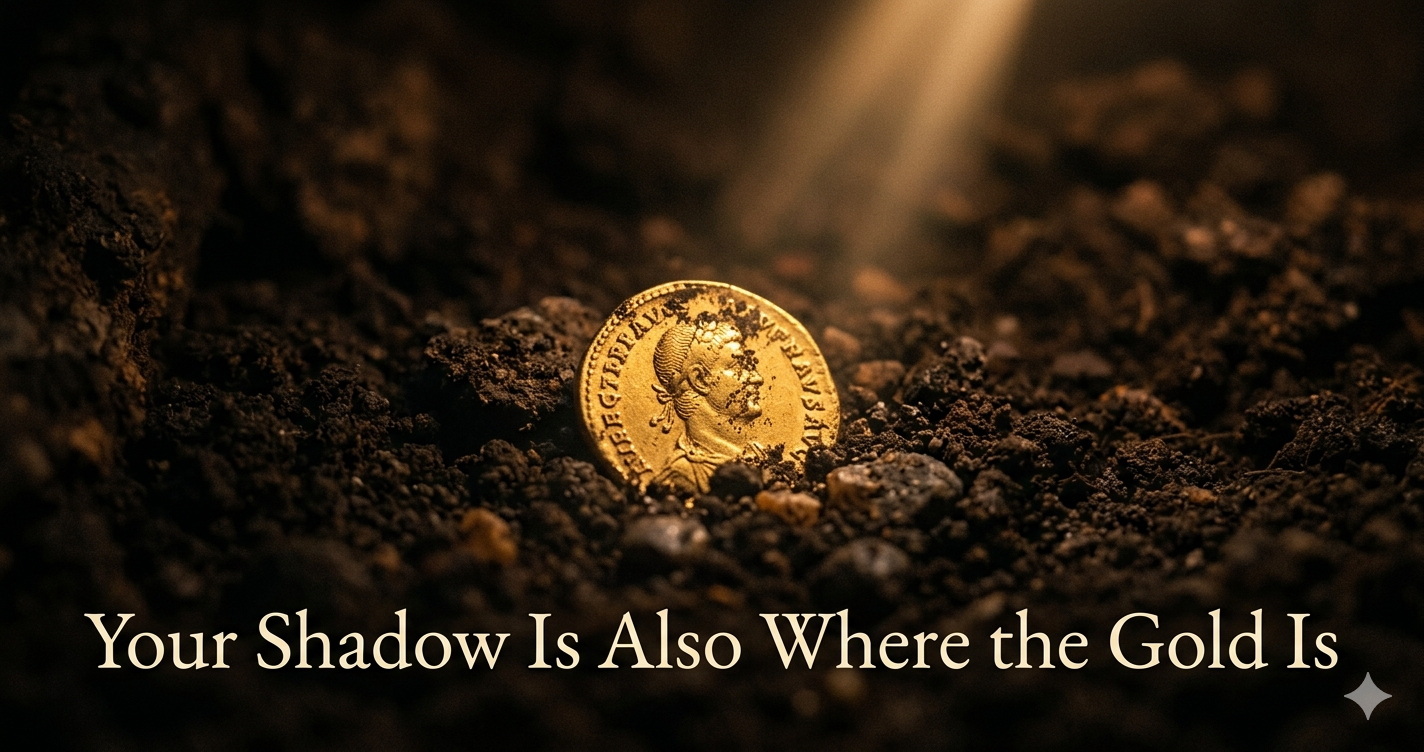
Your Shadow Is Not Only Where the Wounds Are. It Is Also Where the Gold Is.
listen by clicking the audio player here:
In this episode you will learn:
You were taught the shadow is only the dark room where shame lives. That is half the truth, and the missing half changes everything.
In this episode you will learn:
• Why the shadow hides your buried gifts and not only your wounds, and what Jungian depth psychology calls the golden shadow.
• How a real gift gets buried, usually to belong, and then gets mistaken for humility, when Scripture calls the burial fear.
• How to locate your own buried gold, including the clue hidden in the people you most admire, and how to take the first small step to recover it.
Heal Deeply. Walk Holy.
Episode Length: 19:00
can’t get enough? sign up for free 5-day email series here

Transcript
For five episodes now, every single time I have said the word shadow, you have pictured a basement. The dark room where you keep what you are ashamed of. I need to tell you today that you have been looking at half a map. There is a whole other half, and nobody warns you about it. Some of the very best of you is also down there in the dark. Some of your gold is buried too.
BRAND INTRO (0:25 to 2:45)
I am Angela Meer, and I welcome you into the sacred meeting place where the timeless patterns of Scripture meet the deep symbols of the soul. This is The Christian Jung Podcast. This is week six of the shadow arc, and the title of today’s episode is Your Shadow Is Not Only Where the Wounds Are. It Is Also Where the Gold Is.
Now, I can already feel a particular resistance in some of you, so let me deal with it right at the front. When I start talking about your gifts, your gold, the best of you, something in the serious Christian tightens. Because claiming your gifts sounds like pride. We were taught that humility means thinking less of yourself, making yourself small, never making too much of what you can do. And “becoming who you were made to be” can sound like self-help in a thin Christian coat.
So here is the floor we are standing on today, and it is Scripture, not psychology. Jesus told a parable about a servant who was given something valuable, and who buried it in the ground to keep it safe, and who handed it back unused. And Jesus did not commend that servant. He was not gentle about it. We are going to spend real time in that parable today, because it means that hiding a gift is not the humble, careful, spiritual choice we have told ourselves it is.
[pause]
It is time to awaken holy wonder.
[music]
WHY THIS MATTERS PERSONALLY (2:45 to 7:15)
Let me tell you about a gift I buried, and then dug back up.
When I was a child, I took Scripture more seriously than almost anything else in my life. I read it. I memorized it. And then, because I have never been able to leave a true thing just sitting there unused, I implemented it. I was the implement-queen. If the Bible said it, I wanted to do it.
When I was about thirteen, I was reading the fourteenth chapter of First Corinthians, and it honestly confused me. Paul is writing about prophecy as if it were an ordinary thing. Something that might happen in your own living room. A way of loving and encouraging the people right around you. And then he just says it, plainly, that we should eagerly desire to prophesy. That is First Corinthians 14, verse 1. So, being who I was, I went and found my pastor, and I asked him how. How do I actually do this. And he looked down at me, and he patted me on the head, and he said, “Aren’t you cute.” And he walked away.
I want to be fair to him. He did not mean it as a wound. But it landed as one. And something in me quietly filed that moment away, and the lesson it taught was simple. The part of Scripture I was most drawn to was not a serious part. It was a cute part. A child’s part. Something I would grow out of.
Years later, I was sitting in a theology conference, at a seminary, and the presenter said, from the front of the room, that theologians had now dissected the entire Bible, word by word, and found meaning everywhere in it. Everywhere, he said, except the Song of Songs. Who knows what is going on with that weird little book. And the room laughed.
I did not laugh. Because in that moment I understood something about myself, and it was not comfortable. I have never come to Scripture the way that room came to it. I do not come to the Bible first as an academic exercise, a careful dissection of the Hebrew and the Greek. I come to it, and I am pulled, every single time, straight to the parts that room was laughing at. The supernatural. The miraculous. The dreams and the visions everyone finds embarrassing. The weird little book nobody can explain. I read Scripture in symbols, because symbol is the language I have always believed God actually speaks.
And for a long time, I treated that as the thing to hide. The unserious thing. The thing that would keep me out of the rooms I wanted to be respected in. So I buried it. And I worked hard at fitting in.
Here is what I know now. That buried instinct was never the childish thing. It was the gift. It is the exact instinct that lets me do the work I do now, braiding Jungian psychology and theology together, taking the symbols and the dreams and the strange supernatural seams of Scripture seriously instead of laughing them off. The thing I buried in order to fit in was the thing I was made to do. My shadow was not only holding my wounds. It was holding my gold.
That is why this matters. Not as a concept. Because you have a hole in your own yard, and I would like to help you find it.
DEFINING THE CONCEPT (7:15 to 12:00)
So let me define the idea plainly. The phrase is the golden shadow, and it comes from Jung, and here is what it means.
For five weeks we have used the word shadow to mean the part of yourself you have pushed out of sight because you are ashamed of it. The anger. The envy. The wound. That is real, and it is true. But Jung, working with people for decades, noticed something else. He noticed that the shadow is not picky. It does not only swallow what we are ashamed of. It also swallows what we could not afford to own. And sometimes what we could not afford to own was good. A talent. A boldness. A largeness. A brightness that, in some specific room, at some specific age, was simply too much, or too inconvenient, or too costly to keep out in the open.
So that gift goes into the shadow too. Not because it was bad. Because it was dangerous to belonging. And that is the golden shadow. It is the treasure you put in the dark.
Now here is the part I most want you to hear, because it is the part that is hard to believe about yourself. A buried gift does not feel like a buried gift. It does not announce itself. From the inside, it usually just feels like a blank. Like a thing you are not. You will say, quite sincerely, “Oh, I am not creative,” or “I am not a leader,” or “I am not the kind of person who does that.” And you will believe it completely. That is what a well-buried gift feels like. It feels like an honest statement of your limits. Most of the time, it is not. It is a hole, grown over with grass, and you have walked across it so many times you have forgotten it is not solid ground.
REAL JUNG (12:00 to 17:30)
Let me stay with Jung for a few minutes, because he gave us one genuinely useful tool for finding the hole, and I do not want to flatten it.
Jung observed something he called projection. And projection, very simply, is this: the things we cannot own in ourselves, we tend to see in other people instead. We usually talk about projection on the negative side. The traits I cannot stand in you are often the traits I have not faced in me. That is true. But Jung said the same machinery runs on the gold. The gifts I cannot own in myself, I will tend to see, and admire, and sometimes envy, in someone else.
So here is the tool. If you want to find your buried gold, do not start by staring at yourself. Start by looking, honestly, at who you admire. And I do not mean who you casually like. I mean the admiration that has a little ache in it. The person whose ease in front of a room makes something tighten in your chest. The writer whose work you love and also cannot quite read without a flicker of something that feels like envy. The friend whose boldness you praise a little too often.
Jung’s claim, and I have found it true in my own life and in the lives of the people I have walked with, is that this kind of admiration is very often a gift of your own. A gift you handed to someone else for safekeeping, a long time ago, because you did not believe you were allowed to carry it yourself. The ache you feel is not really envy. It is recognition. It is your own gold, calling to you, from across the room, wearing someone else’s name.
SCRIPTURE (17:30 to 27:00)
So let us go to Scripture, and let us start where I promised, with the parable.
Matthew 25. A man is going on a journey, and he calls three servants, and he entrusts each of them with a portion of his wealth. Talents. To two of them, something remarkable happens. They take what they were given, and they put it to work, and it grows. But the third servant does something that I want you to look at very closely, because we have misread it for most of our lives. The third servant takes what he was given, and he digs a hole in the ground, and he buries it. And when the master comes back, the third servant digs it up and hands it over, exactly as he received it. Nothing lost. Nothing risked. Nothing spent.
Now. We read that servant as lazy. He is not lazy. Digging a hole is work. Look at how he describes himself. He is careful. He is cautious. He did not gamble with what was not his. He kept his head down and he kept it safe. If you put that servant in most of our churches, we would call him humble. And the master does not. The master is grieved, and then the master is severe. And the servant himself tells us why he did it. Listen to his own words, Matthew 25, verse 25. “I was afraid, and I went and hid your talent in the ground.”
I was afraid. There it is. The burial was never humility. The burial was fear, and the servant was honest enough, at the end, to call it by its name.
Now hold that next to how God actually calls people, because the pattern is so consistent it should change how you hear His voice. Gideon. The angel of the Lord finds Gideon hiding, threshing wheat down in a winepress so the enemy will not see him, and the very first thing the angel says is, “The Lord is with you, O mighty man of valor.” Judges 6, verse 12. Mighty man of valor. Said to a man in a hole, hiding. And what does Gideon say back? He says, you have the wrong person. “My clan is the weakest in Manasseh, and I am the least in my father’s house.” Judges 6, verse 15.
You hear it? God names the gold. Gideon names the hole. God says valor. Gideon says least. And it is not that one of them is lying. It is that Gideon genuinely cannot see what God can see. The gift is real, and it is buried, and the burial has gone on so long that the smallness feels like simple honesty.
It is the same with Moses. God calls him, and Moses says, “Who am I?” and then, “I am not eloquent.” Exodus 3 and 4. It is the same with Jeremiah, who says, “I am only a youth.” Jeremiah 1, verse 6. Every time, the person reaches for self-diminishment. And every time, God does not accept it. Not because God wants them puffed up. But because the smallness was never true. Paul says it exactly: we have this treasure in jars of clay. Second Corinthians 4, verse 7. The clay is real. We stay honest about the clay. But there is treasure in the jar, and a jar was made to be poured out, not sealed.
And Catherine of Siena, the great fourteenth-century mystic, a woman whose enormous gifts her own age kept trying to make smaller, wrote one line to a discouraged follower that I want you to carry out of this episode. She wrote, “If you are what you should be, you will set all of Italy ablaze.” Hear what she did not write. She did not write, if you are more than you are. She wrote, if you are what you should be. The fire is not in becoming larger than God made you. The fire is in stopping the burial.
MID-EPISODE CTA (27:00 to 28:30)
I want to pause here for a moment. If this episode is putting words to a hole you have been walking across for years, I want you to come and find me. Go to Substack and search for The Christian Jung. The free article this week walks through all of this in a form you can sit with slowly. And inside The Inner Room, the paid companion, I teach the three practices for actually recovering a buried gift: how to track where your body comes alive, how to pray back the gold you have handed to the people you admire, and how to make a written inventory of what you buried and what you were told the day you buried it.
The episode helps you find the hole. The Inner Room hands you the shovel. Go to Substack and search for The Christian Jung, or come to angelameer.com.
Now, the three things I want you to carry out of this.
THREE TEACHING POINTS (28:30 to 38:30)
Movement One: The Shadow Buried Your Gifts, Not Only Your Faults.
This is the turn of the whole episode. For five weeks the shadow has been the basement of shame. Today it becomes something larger and more hopeful. The same darkness that holds the wound holds the gold. Which means shadow work is not only the grim, necessary excavation of what hurts. It is also a treasure hunt. Some of what you have been missing, some of what you have grieved without knowing you were grieving it, is not gone. It is buried. And buried is a very different word from gone.
Movement Two: Burying a Gift Is Not Humility. It Is, Almost Always, Fear.
I need you to take the third servant with you. When you feel that familiar, spiritual-sounding pull to make yourself small, to wave off the gift, to say “oh, that is not really me,” I want you to hear the servant’s own confession underneath it. “I was afraid.” Not always. Discernment matters. But far more often than we admit, the thing we have been calling humility is the thing the parable calls fear. And once you can tell those two apart, you cannot un-know it. Real humility is not burying the gift. Real humility is agreeing with God about the size He made you, and then doing the frightening thing of living at that size.
Movement Three: What You Admire in Others Is a Map to Your Own Buried Gold.
This is the practical one, the one you can use tonight. Think of the person you admire with that small ache. Do not push the ache away and do not let it curdle into envy. Get curious about it instead. Ask it a question. Ask: is what I am aching toward in them actually a gift of my own, that I handed away because I did not believe I was allowed to carry it? Sit with that. Bring it to God and ask Him plainly. Because the people you admire are not just people you admire. Some of them are holding a map, and the buried treasure it leads to is yours.
RECAP (38:30 to 40:30)
So let me bring it home. Three movements. One, the shadow buried your gifts, not only your faults. Two, burying a gift is not humility, it is almost always fear. Three, what you admire in others is a map to your own buried gold.
And if you carry one practice out of this episode and into your week, let it be this one. Start a single note, tonight, and title it “Where I came alive.” For one week, just catch the moments something in you genuinely lifts. Not the moments you performed well. The moments you felt awake. Do not analyze them. Just collect them. And at the end of the week, read the whole list at once, and watch where it points. Your body has been keeping the address of your buried gift the entire time. You just have to start writing the street names down.
FINAL CTA (43:30 to 44:30)
Subscribe to The Christian Jung Podcast wherever you listen. Share this episode with someone who set a gift down a long time ago. Find me at angelameer.com, or on Substack as The Christian Jung, where the free article and the Inner Room companion for this episode are waiting for you.
You were not made small. You were made a particular size, with particular gold in you, and God would like it back in circulation. Next week, we turn to the parts of you that have seen all of this, the wounds and the gold, and still will not move. The resistance with its own logic.