

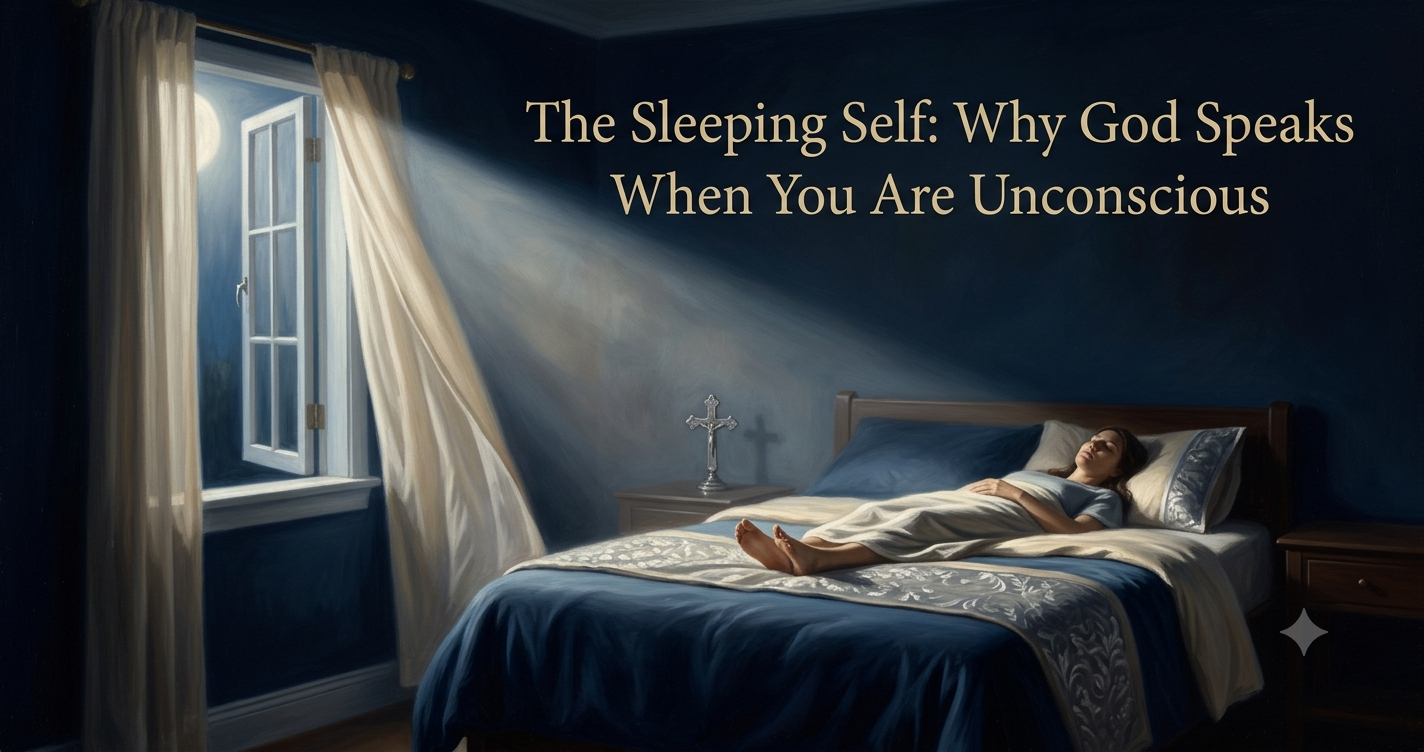
E.2-13: The Sleeping Self: Why God Speaks When You Are Unconscious
Season 2: Episode 13
The Sleeping Self: Why God Speaks When You Are Unconscious
listen by clicking the audio player here:
In this episode you will learn:
The article is about
why the sleeping state is one of the soul's most open moments
and what becomes available to God when the managing, performing version of you goes off duty.
Episode Length: 14:00
can’t get enough? sign up for free 5-day email series here

Transcript
The version of you that manages, edits, performs, and decides is only available when you are conscious. And here is what that version does, all day long, without your full awareness: it filters. It decides what to let in and what to keep out. It shapes what you allow yourself to feel, what you permit yourself to know, what you are willing to hear. You have been doing this so long you do not notice you are doing it anymore. And then you fall asleep. And the filtering stops. And what has been waiting on the other side of the filter begins to speak. Job 33 describes this precisely: God speaks once, twice, though man does not perceive it -- in a dream, in a vision of the night, when deep sleep falls on men. The sleep is not the absence of God's speech. It is the first moment of the day when you have stopped talking over it.
INTRO -- after music]
I'm Angela Meer, and I welcome you into the sacred meeting place of psychology and theology, where the timeless patterns of Scripture meet the deep symbols of the soul.
We are in Week 2 of the Dreams Arc. Last week we established the biblical ground: dreams are woven into the central movements of Scripture, the church's dismissal of them is historically recent, and you were right to take yours seriously. This week we go to the deeper question: why does God speak through the sleeping state specifically? What is it about being unconscious that opens a channel that the waking hours often close? I want to name what some of you are already thinking: isn't this just psychology? Isn't talking about the unconscious and what the sleeping self receives just a dressed-up way of saying your subconscious is doing something your conscious mind doesn't notice? And my answer is: yes, partly. And also, God uses the subconscious. He made it. He moves in it. And the Scripture we are going to look at today is not describing a psychological phenomenon that happens to have a spiritual interpretation. It is describing a theological reality that psychology helps us understand with more precision.
It's time to awaken holy wonder.
[MUSIC STING]
I want to start with something personal, because this week's content is not abstract for me.
There was a season of my life where I was building ministry hot and fast. The ideas were flowing, people were responding, and it seemed like everything was on track to go very well. The numbers were growing. The reach was expanding. Everything the visible metrics of ministry success could measure was pointing upward. And the waking version of me -- the managing, performing, forward-moving version -- was filtering beautifully. She was letting in the evidence that the plan was working and keeping out any information that might complicate it.
Then I had The Dream.
I call it The Dream -- in capital letters -- because it was a dream that immediately made me stop and have to rethink everything. Not because the content was dramatic. Because it was precise. It pointed at something I did not want to look at: the fact that I was building ministry, but not producing fruit. And I know what you might want to say -- all those people being impacted by your ministry, surely that counts. But The Dream drew a line I had not drawn for myself, and it would not let me blur it: impact is not transformation. Transformation is not fruit. The waking version of me had been successfully not seeing that distinction. The dream saw it clearly and named it.
The Dream asked me to stop. All of it. All at once. Right in the middle of the biggest numerical boom my ministry had seen.
I did not initially want to recognize The Dream. I did not want to obey. I went to counselors trying to wiggle my way out of what I had heard. I postponed with God. Until finally The Dream kept replaying -- not just in my sleep, but in my waking hours, in my prayer, in the quiet moments the busy ministry life could not quite fill -- and I had to admit what it was actually saying. I was not building what God wanted me to build. And to be really truthful: I was just building a ministry at the altar of my ego. Ouch. But praise God that He sent a dream. Because the dream shook open what my ego did not want to see, could not see, had been successfully preventing itself from seeing through all the motion and momentum and apparent success.
That is the compensatory dream. And that is what this episode is about.
[DEFINE THE CONCEPT -- 3:00-8:00]
Let me define what we mean by the compensatory dream, because this is the theological and psychological concept that carries the whole episode.
Jung observed that the dream does not simply replay the day or process sensory input. It responds. Specifically. Precisely. To what the waking attitude has excluded. He called this the compensatory function of the dream: the dream supplies the counterweight to the ego's one-sidedness. If the conscious life is too confident, the dream will bring the vulnerability that confidence is covering. If the heart is avoiding something, the dream will find a way to put it in the room. If the ego is running a particular self-image very efficiently, the dream that breaks through it will arrive with the urgency of something that has been waiting a long time to be heard.
For the Christian, this is not merely psychology. It is the mechanism Job is describing in chapter 33. God speaks -- but man does not perceive it. The perceiving is blocked. And then: when deep sleep falls on men, he opens the ears. The filter goes offline. The ego's gating function diminishes. And what God has been saying -- sometimes for a long time, through the waking hours where it could not get through -- becomes audible.
The sleep is not the absence of God's voice. It is the removal of what was blocking the hearing.
[REAL JUNG -- 8:00-15:00]
I want to give you the actual Jungian concept here, because the compensatory function is one of Jung's most theologically useful observations.
Jung's clinical work led him to a consistent finding: the dreams of his patients were not random. They were specifically responsive to the one-sidedness of the waking personality. A patient who was running on unexamined confidence would dream of failure or exposure. A patient who was suppressing grief would dream of weeping. A patient who was building something for the wrong reasons -- and here I am not quoting Jung but recognizing my own story in his framework -- would dream of the gap between what was being built and what was actually needed.
Jung wrote in his essay 'On the Nature of Dreams' that the dream is the natural reaction of the self-regulating psychic system. The psyche -- what Scripture calls the soul -- has a built-in corrective function. When the conscious attitude has wandered too far from what is actually true, the unconscious produces compensating material to bring the whole system back into balance. This is not comfortable. It is necessary. And it is, I would argue, a profound mercy.
The mercy is this: the soul will not let you stay indefinitely in a self-deception that costs you. It will find a way to break through. The dream is one of the primary ways it does. And if the dream is not received, if the compensating material is argued away or counseled away or postponed away, the psyche will escalate. The dream will repeat. The urgency will increase. Until either the information is received and integrated, or the cost of not receiving it becomes greater than the cost of looking at it.
I know which one I chose, and I know how long I postponed it. And I know that the dream was more faithful to me than my own ego was.
[SCRIPTURE -- 15:00-25:00]
Let me take you to the texts.
Job 33:14-16: For God speaks in one way, and in two, though man does not perceive it. In a dream, in a vision of the night, when deep sleep falls on men, while they slumber on their beds, then he opens the ears of men and terrifies them with warnings. I want to sit in that phrase: he opens the ears of men. The ears were closed. Not because God was not speaking. Because the perceiving was blocked. And the deep sleep -- the unconscious state, the moment when the filtering self goes offline -- is specifically identified as the moment the ears open. The structural logic of this passage is that sleep removes what was blocking the hearing. The night is not a spiritual gap. It is a spiritual opening.
Psalm 127:2 in its alternate rendering -- closer to the Hebrew -- does not say He gives sleep to his beloved. It says He gives to his beloved in sleep. The preposition matters. The giving is not sleep itself. The giving happens in the sleep. The night is a medium of gift, not merely a period of rest.
Psalm 4:4: Ponder in your own hearts on your beds and be silent. David is not describing sleeplessness and worry. He is describing a practice of interior attentiveness in the night -- the willingness to be still and let what is there be there, without managing it, without performing for it, without immediately resolving it into something more comfortable. The silence of the bed is a spiritual posture. The pondering is an act of receptivity.
And Ecclesiastes 5:3 offers a caution that is also an illumination: a dream comes with much business. The busy life, the life of much business, generates its own dreams. Some of what we receive in the night is simply the processing of the day's overload. But even that observation assumes the dream is worth attending to rather than dismissing. The Preacher is not saying dreams are meaningless. He is saying the source matters -- and that discerning the source is part of the wisdom the dreaming Christian needs. We will come to discernment in a later week. For now: the busy life generates material in the night. And some of that material is more than processing.
[MID-EPISODE -- around 30 min]
If this episode is naming something you recognize -- if you have had a dream that felt compensatory, that felt like it was bringing what the waking life had been keeping out -- I want to invite you to go deeper. Go to Substack and search for The Christian Jung. The full article for this week is there, and the Inner Room companion walks through the compensatory pattern specifically -- how to recognize it in your own dream life, and two practices that prepare the soul to receive in the night rather than simply to rest. One of them is a pre-sleep examen from the Ignatian tradition, adapted for the dreaming Christian. Come join us.
[THREE TEACHING POINTS -- 25:00-35:00]
Three things to carry from this episode:
The first: the waking self filters, the sleeping self receives.
All day long, the managing, performing conscious self decides what to let in and what to keep out. It is doing this right now, as you listen, selecting what to admit and what to deflect. Sleep removes that selection process. The filter goes offline. And what has been waiting -- sometimes for a very long time -- surfaces in the only space where the defenses are not running. The sleeping self is not the lesser self. It is the more honest one. It cannot perform. It can only receive.
The second: the compensatory dream brings what the waking life has excluded.
The dream is not random. It is specifically responsive to the shape of what you have been filtering. If the ego has been running a particular self-image efficiently, the compensatory dream will bring the shadow of that self-image. If the conscious life is too one-sided in any direction, the dream will bring the counterweight. This is the mercy built into the soul's architecture: you cannot stay indefinitely in a self-deception that costs you. The night will find you.
The third: impact is not transformation, and transformation is not fruit.
I want to leave this with you not as a theological proposition but as a question. It is the question The Dream asked me, at the height of my most visible ministry success. Are you building what God wants built, or what your ego wants built? Are you producing impact, or transformation? Are you producing transformation, or fruit? These are not the same question. And the waking life, with its metrics and momentum and visible response, is often not the best place to answer them. But the night -- the honest, undefended, filter-free night -- will ask the question. And it will keep asking until you answer.
[RECAP]
The sleeping self is the receiving self. The filter goes offline. Job 33 names the mechanism: God opens the ears when deep sleep falls, because the perceiving that was blocked during the day is finally available. The compensatory dream brings what the waking life has excluded. And sometimes what it brings is the most important information available to you -- the kind that only reaches you when the managing, performing version of you has finally gone to sleep.
[PAUSE PRAY HEAL]
Let's close with a moment to Pause, Pray, and Heal. Take a breath. If The Dream has already been sent to you -- if there is something that has been replaying that you have been postponing -- let this be the moment you stop postponing.
[Pause]
A prayer of John of the Cross, who understood the dark night as God's most intimate approach:
O Lord, you who work in the night what the day cannot hold -- open what I have kept closed. Reach what I have kept defended. Say in the darkness what I have been too busy and too defended to hear in the light.
And before you sleep tonight: write one sentence. The thing I have been most successfully not thinking about this season is ___. Just name it. Then sleep. And see what the night brings.
[FINAL
Subscribe to The Christian Jung Podcast wherever you listen and share this episode with someone who has been performing around a truth the night has already tried to send them. Find me at angelameer.com or on Substack as The Christian Jung. Next week: the language of dreams -- why God speaks in symbol and image, and what it means to dwell in the imagery rather than immediately explaining it away.
Heal Deeply. Walk Holy.
[END]