

E.2-14: The Vocabulary of Dreams: Signs and Symbols as God's First Language
Season 2: Episode 14
The Vocabulary of Dreams: Signs and Symbols as God's First Language
listen by clicking the audio player here:
In this episode you will learn:
The article is about
God's first language in Scripture is signs and symbols, not statements, and dreams work the same way.
• We've traded the numinous for the explainable, and lost something the soul actually needs in the process.
• A sign has a fixed meaning; a symbol carries meaning within itself, which is exactly how Scripture describes God.
Episode Length: 24:00
can’t get enough? sign up for free 5-day email series here

Transcript
You have sat with a dream before, turned it over and over, reached for a symbol dictionary, and tried to solve it like a math problem. And maybe you got an answer. But if you are honest, the answer felt thin. It explained the dream without ever touching what the dream actually did to you. I want to suggest something today. The first language of your dreams was never meant to be decoded by your intellect. It was meant to be met by something deeper in you. And most of us have not been taught how to do that at all.
Intro (0:30-1:45)
I'm Angela Meer, and I welcome you into the sacred meeting place of psychology and theology, where the timeless patterns of Scripture meet the deep symbols of the soul. This is The Christian Jung Podcast.
We are in week four of our ten week series on the dreaming life, and today we are asking a question that sounds simple but goes very deep. If God speaks through dreams, what language is He actually speaking? Now, some of you hear the word symbol and immediately think of tarot cards or dream dictionaries sold in the checkout aisle, and your discernment goes up. I understand that. But what I want to show you today is that symbol was God's idea first. Daniel did not get a memo. Ezekiel did not get a summary paragraph. They got wheels, and fire, and eyes, and thrones, because that is how God has always chosen to describe Himself when words alone were not enough.
It's time to awaken holy wonder.
Personal Relevance (1:45-9:30)
I want to tell you about a dream I do not talk about often, because it still feels almost too sacred to hand over casually.
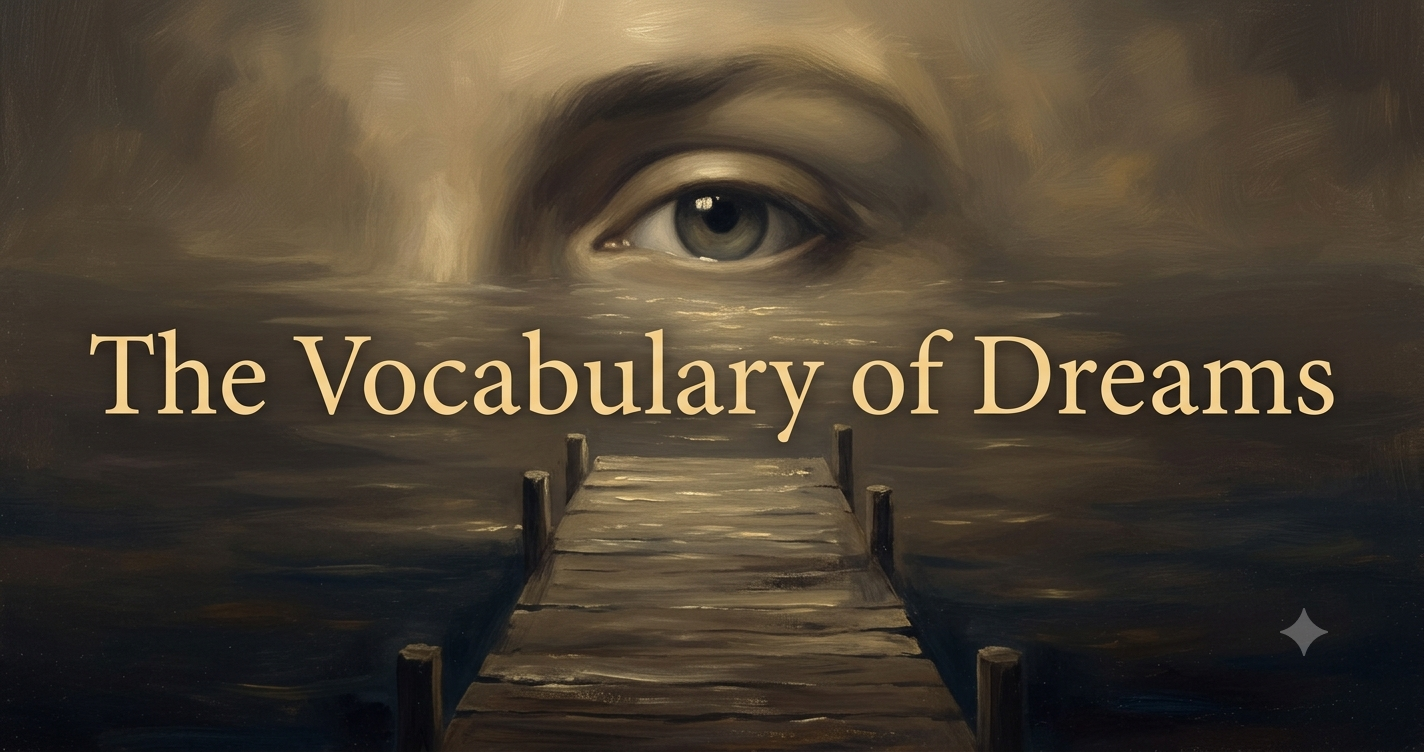
In the dream, it is dark, and I am seeing by moonlight. I am walking along a simple wooden dock that stretches out into a large body of water. I get to the end of the dock and I look down. The water is rippling with something larger than I can imagine moving beneath the surface. And then, slowly, an eye begins to emerge. The eye is enormous. Bigger than a whale's eye. And here is the strange part. I am not afraid in the normal sense. I am afraid in the holy sense. The eye looks at me as if I am completely known, loved, and cherished, all at once. I cannot stop staring at it. And in the last second before it submerges again, I realize what I am looking at. I am looking at the Ancient of Days.
Most people, when I describe that dream to them, say the same thing. That sounds like a nightmare. An enormous eye rising out of dark water sounds like something out of a horror film, not a spiritual encounter. But it was, without exaggeration, one of the most significant spiritual encounters of my life. When I woke up, my room still had its ordinary amber glow from my nightlight, but the air felt filled with something. I was buzzing with it. I felt fully known, fully seen, fully loved, all at the same time. God, as the Ancient of Days, used a dream and a symbol to reveal a part of His nature to me that words alone had never quite reached.
And here is what I want you to sit with. He did not send that through a podcast. He did not send it through my intellect. He did not send it through a vague good feeling during worship. He sent awe, specifically, through a dream.
If someone had simply told me, Angela, God sees you completely and loves everything He sees, I would have nodded, agreed, filed it under what I already believe theologically, and gone on with my day. That sentence is true. I already believed it. But truth as words and Truth as felt, lived reality are two very different ways of knowing God, and only one of them has the power to actually rearrange you. That eye did not teach me a new doctrine. It rearranged something in me that doctrine alone had never been able to reach.
That is what symbol does that a statement cannot do. And that is exactly what I want to unpack with you today.
I tell you that dream not to impress you with its strangeness, but because I think a lot of you have had a dream like it and never told a single person, because you did not know what category to put it in. It did not feel like a warning dream. It did not feel like a compensatory dream, the kind we talked about last week. It just felt holy, and huge, and slightly outside what your church experience gave you language for. If that is you, I want you to know today that there is nothing wrong with you, and nothing wrong with the dream. You simply met God in the one language He has been speaking since before you had words at all.
Define the Concept: God's First Language (9:30-18:00)
Here is the premise I want to lay down clearly. God uses signs and symbols as His first language in the Bible. Yes, He spoke in Hebrew, and in Aramaic, and in Greek. But underneath the words, His preferred grammar has always been image. And I think the reason so many of us do not understand our own dreams is not that we are bad at interpretation. It is that God is trying to develop an actual language with us, one that is built on relationship and on understanding our personal calling in the world, not on a lookup table.
God will use dreams to bypass your intellect, on purpose, because we rely on our intellect far too heavily. I say that as someone who is currently a PhD theology student. I love the intellect. I love rigor. But because I was raised on the mission field, I still have a space in my soul for the mysterious, the unexplained, the numinous, in a way that a lot of our current Christian landscape has quietly trained out of people. We want answers. We want equations. And I would even say this is part of why so many Christians are afraid of artificial intelligence right now. We have started to believe our intellect is all we are. It is not. And we are not just biology either. Plenty of psychologists treat the psyche as purely biological, as something that reduces down to neurology. But neuroscientists themselves are clear that consciousness is not simply located in the brain the way we assume.
As far as I know, Carl Jung is the one psychologist who recognized the psyche as something closer to what Scripture calls the soul. He saw it as having its own cosmology, its own patterns, its own way of making sense of the world. And he was far more interested in healthy psychological life than in pathology, which made him unusual in his field.
Here is the piece I most want you to hold onto. Jung said the psyche speaks in symbol and in sign. And that the psyche has what he called a religious function. In other words, your dreaming mind is speaking, structurally, the same language as the biblical prophets, the same language behind the dreams sent to ordinary people night after night, the same language received by saints, mystics, and early church fathers for two thousand years.
When we try to boil our dreams down to pure intellect, we get stuck, and honestly, for good reason. For weeks now, one verse has been on repeat in my spirit. Lean not on your own understanding. Proverbs 3:5. We have become remarkably good at leaning on our own understanding. Dreams confront that, gently, in the one part of the day when the managed, explaining mind is finally, mercifully offline.
Think about why relationship, by nature, has to be built on more than statements. If I only ever gave you facts about myself, my age, my job title, the city I grew up in, you would have information about me, but you would not know me. You would know me if I let you into an image, a memory, something felt rather than filed. That is exactly the difference between a sign and a symbol, and it is exactly why God, who wants to be known and not merely believed in, keeps reaching for image over statement.
This also connects directly to calling, which is where I think a lot of us miss the point of our own dream life. We tend to think our calling should arrive as a sentence: go do this specific job, move to this specific city, say yes to this specific opportunity. Sometimes it does. But more often, calling arrives the way Daniel's throne room arrived, or the way my dock arrived, as an image that has to be lived with before it fully resolves into direction. If you are waiting for God to hand you your calling in a single clear sentence, you may be waiting for the wrong kind of language entirely. He may already have handed it to you in a symbol you have not finished sitting with yet.
Real Jung, and Otto (18:00-26:00)
There is a feeling the German theologian Rudolf Otto named the mysterium tremendum et fascinans, the sense of the Holy Other as simultaneously overwhelming and inviting, terrifying and near, wholly strange and yet personally close. Jung borrowed Otto's word for that feeling, numinosity, and used it constantly throughout his work, because he understood that the intellect needed to be confronted by something it could not fully metabolize.
We have lost the numinous, largely, and traded it in for the explainable. For apologetics. For clarity and precision. And in that trade we have lost the mystery of God and His mysterious ways, even while, night after night, He keeps sending the dream anyway. As if to say: when you have grown tired of intellect, I am here.
We have traded that feeling for clarity. We have traded mystery for explanation. We have traded the image for the proposition. And in doing so, we have gained something real, clarity is not nothing, but we have lost something the soul actually requires. We have lost the capacity to encounter God in His full, incomprehensible dimensions, the dimensions Scripture never stops reaching toward even when it cannot fully contain them. The dream restores the numinous. It restores the next step as a faith step rather than a solved equation. It restores the mysterious Other, the holy God.
Now, here is where I want to slow down and be precise with you, because this is the heart of today's teaching. Jung drew a sharp line between what he called a sign and what he called a symbol, and that distinction is one of the most important in all of depth psychology, and it has direct theological weight.
A sign, Jung said, has a fixed, translatable meaning, like a math equation. A red light means stop. The word cat refers to the animal. A sign can be swapped out for what it points to without any real loss. Its entire job is to point, and once you have received the point, the sign has done its work and can be discarded.
A symbol is the opposite. It does not have an equivalent meaning you can trade it for. It cannot simply stand in for a person, a place, or a thing. A symbol, Jung said, carries its meaning within itself, through the emotion it evokes, through a message that resists being flattened, through a mystery that needs real time to unfurl. Often, a true symbol will exhaust every attempt you make to fully explain it. The eye in my dream is a symbol in exactly that sense. I can tell you I was looking at the Ancient of Days. I would need another ten years to fully relate what that eye actually meant to me in that moment, and I am not sure ten years would be enough.
Daniel was in the same position I was. When he first wrote about the Ancient of Days, he did not reach for a tidy sentence. He used the full visionary experience of Daniel chapter seven: a throne, fire, flowing flames, garments white as snow, a court of ten thousand times ten thousand. Ezekiel, also seeing eyes, did not write, well folks, God is omniscient. He wrote the symbols of Ezekiel chapter one exactly as he received them: wheels within wheels, eyes on every side, chariots of fire. When God is described in Scripture, He is described in symbol. That is not a stylistic accident. That is precisely why we need to prioritize our dreams in our Christian walk instead of quietly filing them under things we do not have time for.
Anchor in Scripture (26:00-34:00)
Let's put a few more passages next to each other, because seeing them together makes the pattern impossible to miss.
Psalm 139 says it plainly: You have searched me and known me, Lord. You know when I sit and when I rise. You perceive my thoughts from afar. Where can I go from your Spirit? Where can I flee from your presence? Such knowledge is too wonderful for me, too lofty for me to attain. That phrase, too lofty to attain, is not a failure of theology, even though our culture would tell you it is. It is the right posture toward a God who has always exceeded our categories, and He sends the dream, in part, to remind us of exactly that.
The contemplative Christian tradition has a name for this posture. Apophatic theology holds that God exceeds every human category, and that every true statement we make about Him is also, at the same time, insufficient. This is not anti-intellectualism. The mystics who held this tradition were not opposed to thinking clearly. They were naming the actual limit of the intellect in the presence of the Infinite. They believed the soul does its best work beyond the reach of the intellect, in a place words and concepts cannot fully follow.
The dream honors that limit in a way propositions cannot. A dream does not simply tell you God is the Ancient of Days. It walks you down the pier and makes you look at the eye. It makes you feel something. It makes your faith stretch in real time. It makes you see God in a place you had not previously known Him. And you walk away fully known, fully seen, outside of any intellectual code that needed cracking in the first place.
This is also why I want to be careful about rushing to interpret every dream the moment it happens. There is a real temptation toward urgent interpretation, and I understand it, but some dreams, like the eye at the end of the dock, are simply a call to be immersed in the feeling first. I could try to interpret that dream fully. I could reduce it to an instruction, a prophecy, an intellectual exercise. But I would flatten it in the process, and I would lose the very thing it was sent to give me.
There is also a real category of dreams that are filled with signs rather than symbols, and those do call for more direct interpretation. Part of maturing in this practice is learning to tell the difference, which is exactly what we build out further in The Inner Room this week. But even with sign-heavy dreams, it is worth taking time to let them roll around in your heart before you rush to explain them away.
I also want to say something to those of you who grew up, like I did, in a Christian culture that prized apologetics and airtight answers above almost everything else. That instinct is not wrong. Being able to give a reason for the hope within you matters, and Scripture tells us to do exactly that. But apologetics was never meant to be the whole of your relationship with God, only the part that defends the edges of it. The center of the relationship was always meant to be encounter, and encounter, by its nature, speaks the language of symbol before it ever speaks the language of proof.
Mid-Episode Invitation (around 34:00)
If any part of this is naming something you have been carrying, come find me. Go to Substack and search for The Christian Jung. That is where this week's free article lives, along with The Inner Room, our paid tier, where this week we take two Ignatian practices of holding a dream and go even deeper, including a technique I use personally that has changed the way I receive significant dreams, and we begin to categorize the kinds of images a dream can offer, because not all of them call for the same posture.
Three Teaching Points (34:00-41:00)
Today's Three Movements of Symbol:
• A sign points, a symbol carries. Signs have a fixed, swappable meaning, and once you get the point, you can set the sign down. Symbols carry their meaning inside themselves, through feeling, through mystery, through what resists a tidy explanation. When God describes Himself, He almost always chooses symbol, because a sign would flatten Him, and He will not be flattened. If your dream keeps returning to the same image without ever fully resolving, that is usually a sign you are dealing with a symbol, not a sign.
• You do not need to decode every dream to receive it. Abiding in a dream, letting it roll around in your heart before you rush to interpret it, is itself an act of hope, and hope does not disappoint. Some dreams are asking to be felt before they are asking to be explained, and rushing past that step costs you the very thing the dream was sent to give. Give the image the same patience you would give a person you were just getting to know.
• What tickles the intellect is not the same as what transforms the soul. Being told God sees and loves you completely is true, and you probably already believe it. Being shown it, through an image too holy to fully explain, is a different order of knowing altogether, and it is usually the one that actually moves you. Do not let the fact that you already believed something theologically talk you out of letting a dream teach you the same thing all over again, felt this time instead of merely known.
One Practical Step Before You Sleep Tonight (41:00-45:30)
I do not want to leave you with only theology tonight, so here is one practical step you can actually use, starting with the very next dream you remember.
When you wake up with a dream still fresh, before you reach for your phone, ask yourself one question first. Does this feel like a sign or a symbol? A sign-type dream usually has a clear, almost obvious point to it. You already sense what it is telling you to do, or stop doing, or pay attention to. Those dreams are worth interpreting fairly directly, the way you would read a warning label. A symbol-type dream is different. It leaves you with a feeling you cannot quite name, an image that keeps returning to your mind uninvited, a sense that there is more here than you can currently access. Those dreams are not asking to be solved. They are asking to be revisited.
If it is a symbol, resist the urge to interpret it the same day. Instead, write down the image itself, as plainly as you can, and underneath it write one word for the feeling it left you with. Not the meaning. The feeling. Awe. Grief. Longing. Fear, the holy kind, not the anxious kind. Then let it sit. Come back to it in a week. You will often find the image has kept working on you quietly in the background, the way real symbols do, and what you write the second time will be truer than anything you could have forced out the morning after.
And if what you are left with is simply a feeling with no clear image attached at all, that still counts. Write the feeling down anyway. Some of what God is forming in you through your dreams will never fully translate into language, and that is not a failure on your part. That is apophatic theology working exactly as it should. Keep a running page in your journal just for these, feelings without full images, images without full explanations, and read back over that page every month or two. You will start to notice a shape to it long before you can name what the shape is, and that noticing is itself the beginning of the relationship God has been trying to build with you through this whole language all along.
A Closing Thought on Waiting (47:30-49:30)
Before we recap, I want to say one more thing to those of you who feel like you have been waiting a long time for God to speak clearly into a situation. It is possible He already has, and it did not look like the kind of speaking you were trained to expect. It looked like an image you dismissed as strange. A dream you forgot to write down. A feeling during worship you assumed was just tiredness. God has never been stingy with His speech. He has simply never been obligated to speak in the dialect we find most convenient. Part of growing up spiritually is learning to recognize His voice in the dialect He actually uses, not the one we would have preferred.
Recap (49:30-51:30)
So today we talked about God's first language: signs and symbols, chosen on purpose, long before anyone had ever heard the term numinosity. We talked about what we lost when we traded the numinous for the explainable, and what Rudolf Otto and Carl Jung both named in that loss. We walked through the difference between a sign and a symbol, and why Daniel and Ezekiel both described God in image rather than statement. We anchored all of it in Proverbs 3:5 and Psalm 139, and we let apophatic theology give us permission to say some knowledge really is too lofty to attain by intellect alone. And I told you about the eye at the end of the dock, because some things are better shown than explained.
Pause, Pray, Heal (47:30-50:30)
Let's end this time with a moment to pause, pray, and heal. Take a deep breath, and rest into what you have received today.
Pause: Think of a dream that gave you a feeling you could not fully explain. Not a dream you understood, a dream you felt. Let that feeling come back for a moment, right now, without rushing to name it.
Pray: this is a prayer from Meister Eckhart. God, you are more than every image of you I have ever held. You are more than what I can name, more than what I can think, more than what I can receive and still call by its right name. Meet me in the place where the naming stops.
Heal: Tonight, before sleep, write one sentence about a feeling you have been trying to think rather than feel. Name the feeling, not the explanation for it. Let the night bring what the intellect cannot reach on its own.
Final (50:30-51:30)
Subscribe to The Christian Jung Podcast wherever you listen, share this with someone who has had a dream they never told anyone about, and find me at angelameer.com or on Substack as The Christian Jung. And if today is the day you finally write that dream down after years of keeping it to yourself, I would love to hear about it.