

E.2-18: Post-Dream Formation: Continuing the Conversation From a Dream
Season 2: Episode 18
Post-Dream Formation: Continuing the Conversation From a Dream
listen by clicking the audio player here:
In this episode you will learn:
The article is about
Nepsis, paying attention, is the first step. It works even if you rarely dream, because it starts with noticing what keeps showing up in your waking life too.
• Synchronicity, Carl Jung's word for meaningful coincidence, is often the soul amplifying a message in the material world so you'll finally notice it.
• Active imagination, modeled by Habakkuk stationing himself on the ramparts, is staying with an image until its meaning settles into your heart instead of rushing to a quick answer.
Episode Length: 29:00
can’t get enough? sign up for free 5-day email series here

Transcript
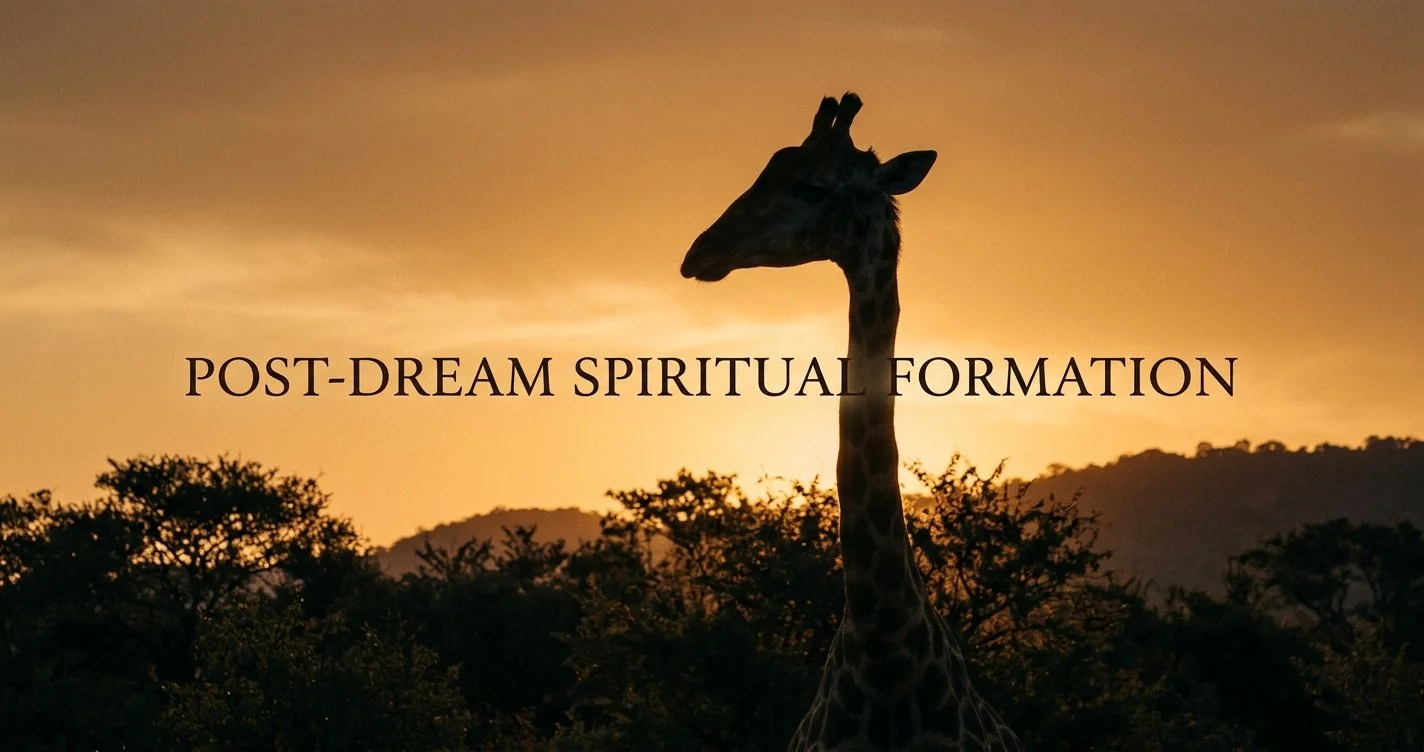
There was a stretch of about three weeks where I could not get away from giraffes. Store windows. A magazine cover at the checkout. Somebody's living room wall. A stranger telling me about the baby giraffe at the zoo, unprompted, in a conversation that had nothing to do with anything I'd brought up. And every single time, I noticed it, thought "huh," and went right back to whatever I was doing. That's what I want to talk about today. Not the giraffe. The going right back.
The dream is not the message. The dream is the first sentence of the message. And most of us close the letter after the first sentence, feel good about ourselves for having opened it at all, and never find out what God was actually writing to us about.
Intro (0:30-1:45)
I'm Angela Meer, and I welcome you into the sacred meeting place of psychology and theology, where the timeless patterns of Scripture meet the deep symbols of the soul. This is The Christian Jung Podcast.
We are in week eight of our ten week series on the dreaming life, and today we're talking about what happens after the dream, or after the sign, ends. Now, some of you hear a phrase like 'active imagination' and immediately brace yourselves, wondering if we're about to drift from careful theology into something that sounds more like a manifestation workshop than a Christian practice. I understand that instinct, and I want to answer it directly instead of letting it sit there unaddressed. Active imagination isn't a New Age import. Ignatius of Loyola built an entire discipline of it in the sixteenth century. The Desert Fathers were doing a version of it centuries before that. What we're recovering today is old, orthodox, and largely forgotten, not new.
Before we dive in, one more housekeeping note for anyone joining this series mid-stream. We started this arc by grounding ourselves in the Biblical case for dreams, then moved through the early church's practices, then spent several weeks on discernment, on nightmares, on how to tell a message from God apart from an attack from the enemy. Today builds on all of that. If any of today feels unfamiliar, I'd encourage you to go back through the earlier weeks in this series, but you don't need to have heard them to get something real out of today.
It's time to awaken holy wonder.
Personal Relevance (1:45-9:30)
Let me tell you about a giraffe.
I dreamt of one, just an ordinary dream, nothing dramatic. And then I started seeing giraffes everywhere. In household decor. Stories in the news. People telling me about their trip to the zoo and a particular giraffe they saw there, or a baby giraffe in the news. Every single day for weeks, it was giraffes. Giraffes in store windows. Giraffes on a magazine cover. Someone mentioning a giraffe in a conversation that had absolutely nothing to do with anything I'd brought up.
And sometimes, y'all, your girl doesn't take the hint.
Finally, after what felt like weeks of giraffes trailing me everywhere I went, I stopped and actually prayed about it. 'God, you're obviously wanting to talk to me about the symbol of a giraffe. What does it mean?' That night, as I lay down, I saw the neck of a giraffe extending up above the trees. From that vantage point, I could see that a giraffe has the ability to spot danger coming from far away, long before anyone else on the ground notices. I saw that it could eat the good leaves that most other creatures simply couldn't reach. And then, without any effort on my part, it settled into my heart. The symbol meant Godly leadership.
For weeks after that, God took me on a personal discovery of what it meant to be a Godly leader in perilous times, one giraffe fact at a time. He wanted me to see danger coming a mile away so I could warn others. He wanted me to know I'd be eating the best leaves, sitting under the best teaching, so I could turn around and teach others what I'd learned. I was in heaven's school for leaders. And it all started with a dream of a giraffe that I very nearly let float away like every other dream I'd ever had.
I want to slow down on one detail, because I think it's easy to rush past. Notice that God didn't just hand me the word leadership and call it finished. He built out an entire curriculum, fact by fact, the way a professor builds a semester instead of handing you a single index card. Danger spotted from a distance, one week. The best leaves reserved for those willing to reach highest, another week. Each new giraffe fact I researched became another session in that curriculum, and I genuinely didn't know, walking into any given week, what the next lesson would be. That unpredictability was part of what kept me engaged with it in a way a single verse or a single sermon rarely manages to sustain over that many consecutive weeks.
Here's a second one, smaller but just as telling. I've been seeing the number 111 up to six times a day for at least six months now. Not once or twice, six times, most days, for half a year. Every time I see it now, I stop and pray a specific prayer that's grown up around what that number has come to mean for me personally. I didn't decide that meaning intellectually. It developed the same way the giraffe did, slowly, through sustained attention, not through a quick lookup in a symbol dictionary.
I want to be honest about something, because I think it matters more than the tidy version of this story. For a long time, before the giraffe, I was the kind of person who noticed these things and then talked myself out of paying attention to them. I'd see the same number twice in a week and think, that's a fun little coincidence, and keep moving. I had years of training, in ministry, in academic work, in ordinary adult busyness, that had quietly taught me to treat the material world as background noise rather than as a place God might actually be speaking. The giraffe broke that habit, not because it was more dramatic than the small signs I'd been ignoring for years, but because it simply would not stop, week after week, until I finally ran out of ways to explain it away.
That's actually part of what I want you to hear today. God is not usually shouting at you through some singular, unmistakable event. More often He is doing exactly what He did with the giraffe: repeating something ordinary, patiently, past the point where a reasonable person would call it coincidence, because He knows how long it takes some of us to finally stop and turn around.
Define the Concept: The Conversation Doesn't End When the Dream Does (9:30-16:00)
Here's the pivotal insight for today. Most of us treat a dream, or a repeating sign, as a single event with a beginning and an end. It happens, we notice it, maybe we write it down, and then it's over. But that's not actually how God tends to communicate through symbols. The giraffe wasn't a single dream. It was the opening line of a conversation that lasted weeks. The number 111 isn't a single sighting. It's an ongoing dialogue, six months and counting.
Post-dream formation is the practice of staying in that conversation instead of closing it the moment the initial dream or sighting ends. It's the difference between reading one verse of a letter and actually reading the whole letter, slowly, more than once, until you understand what the person who wrote it was actually trying to tell you. Most modern Christians, myself included for a long time, are excellent at receiving the first line and terrible at staying present for the rest of the letter.
There's a specific three-step sequence I want to walk you through today that keeps that conversation open: nepsis, synchronicity, and active imagination. Each one builds on the last, and together they turn a single dream image into real, lasting spiritual formation instead of a curiosity you mention once at dinner and forget by the weekend.
I also want to name why this matters so much for those of us in modern Christianity specifically, because I don't think this is a small, optional add-on to an otherwise complete spiritual life. Dreams and the symbols that echo out of them have helped me overcome some of the exact patterns that modern Christianity tends to fall into without even noticing. Falling away from God when confronted by the world's systems. Shaping our faith around cultural trends instead of what our own soul genuinely needs. Deconstructing our beliefs according to our ego's demands rather than along orthodox, biblically grounded lines. Letting the demands of intellectualism quietly outweigh what the Holy Spirit is actually pointing us toward. Post-dream formation, staying in the conversation instead of closing it early, has been one of the most direct correctives I've found against all four of those patterns in my own life.
Real Jung, and the Physicist Who Helped Him Name It (16:00-23:00)
Carl Jung gave us a word for part of what was happening with my giraffe: synchronicity. He defined it as an acausal connecting principle, and he didn't develop that idea alone. He worked it out alongside Wolfgang Pauli, one of the founding fathers of quantum physics, as the two of them tried to understand what actually connects what we might call the heavens and the material earth. In plain terms, synchronicity describes signs and symbols that show up in our lives with no material cause linking them together, a giraffe in a dream and then a giraffe on six different magazine covers in one month, for instance.
Jung called this a meaningful coincidence, and he believed it was the soul attempting to speak into the material world so that we could actually understand what it was saying. I want to translate that directly into language you already use. What Jung called synchronicity, Christians have long called a God-moment, or a little miracle. The mechanism he's describing, a signal in the soul getting amplified into the material world until we finally notice it, lines up remarkably well with how Scripture itself describes God getting our attention, repeating a message until it can no longer be politely ignored.
I want to be careful here, the way I always am when I bring Jung into this conversation. Jung is not the authority on what a repeating giraffe or a repeating number means in your life. He gives us a genuinely useful vocabulary for describing the mechanism, a signal amplified across dream and waking life until we notice. But the meaning behind that signal, the actual content of what's being communicated and who is doing the communicating, has to be discerned with the Holy Spirit, not with Jung's framework alone. Synchronicity tells you something is happening. It doesn't tell you what, or why, or from whom. That's your job, in prayer, to find out.
It's worth noting how seriously Jung and Pauli took this idea, because it wasn't a fringe hobby for either of them. Pauli was one of the most rigorous minds in twentieth-century physics, a man who helped lay the groundwork for quantum mechanics, and he spent real intellectual energy correspoding with Jung about where meaning and causation actually diverge. That two serious thinkers, one a psychiatrist and one a physicist, independently concluded that meaningful coincidence deserved its own category, distinct from ordinary cause and effect, tells you something. The material world is not as sealed off from meaning as our modern, disenchanted assumptions like to pretend. Scripture never assumed it was sealed off in the first place. Jung and Pauli simply rediscovered, from a secular starting point, something the Bible had been saying all along.
Anchor in Scripture: Habakkuk on the Ramparts (23:00-30:00)
Let's put Scripture right next to everything we've said, because this three-step sequence isn't a modern invention laid on top of the Bible. It's already there, especially in Habakkuk.
Habakkuk 2, verses 1 and 2, says this: 'I will stand at my watch and station myself on the ramparts; I will look to see what he will say to me, and what answer I am to give to this complaint. Then the Lord replied: Write down the revelation and make it plain on tablets so that a herald may run with it.' Notice what the prophet does here. He doesn't passively wait for a sign and then walk away when it doesn't immediately resolve. He positions himself, actively, deliberately, to hear more. He has his tablet ready. He's prepared to write down whatever comes and run with it the moment it does. That's nepsis and active imagination in a single verse, a soul that has learned to pay attention and stay present for the whole conversation.
We see the same active posture all through Scripture once you know to look for it. Genesis 15, God tells Abraham to look up at the stars and count them if he can, and that image becomes the promise Abraham holds onto for the rest of his life, not a fact he glances at once and forgets. Ezekiel 37, the prophet doesn't just see a valley of dry bones and move on. He's told to prophesy to them, to stay present with the image until it becomes something else entirely. Jeremiah chapter one, the prophet is shown an almond branch, and God uses the Hebrew wordplay between the almond tree and the word for watching to build an entire calling around a single image Jeremiah could have dismissed as nothing more than a tree.
And then there's 1 Corinthians 2:9-10, which I think names the actual promise underneath all of this: what no eye has seen, what no ear has heard, what no human mind has conceived, these are the things God has revealed to us by His Spirit. That's not a verse about information. It's a verse about revelation that requires staying present long enough to receive it. John 10:10 tells us Jesus came to give us abundant life, and I don't think that abundance is generic. I think it's bespoke, custom-built, arriving through the unique language your particular soul was made to understand, giraffes and 111s included.
I also want to connect this to a practice you may already know by another name: Lectio Divina, the ancient practice of meditating slowly on Scripture, a hymn, or a piece of art until it moves from information into formation. Post-dream formation is Lectio Divina's same posture, applied to a symbol instead of a passage. You don't read a verse of Lectio Divina once and move on. You return to it, slowly, let it work on you over multiple sittings. The giraffe asked exactly that of me. So has 111. The posture is identical even though the material is different.
Mid-Episode Invitation (around 30:00)
If a symbol has been trailing you the way that giraffe trailed me, and you haven't known what to do with it, come find me. Here's a bullet snapshot for the wait list emails:
A Return to Awe — This Fall
Real-time, personal feedback from Angela on your own dreams. Not a symbol dictionary. A direct response to what God is actually showing you.
An interactive lab, not a lecture series. You'll turn a dream's central image into art with your own hands, then bring it into guided group contemplation.
Blends art, theology, and depth psychology into one practice, so you finally have a framework for the dream life you've been having alone for years.
Built for the Christian who has the doctrine down and still feels like something's missing on Sunday night.
Go deeper into God's love than a sermon can take you. This is encounter, not explanation.
Spots are limited because the feedback is personal. Angela can only sit with so many dreams at once.
Early-bird wait list gets first access when doors open, before the general public even hears about it.
CTA: Subscribe on Substack or head to AngelaMeer.com to claim your spot on the early-bird wait list before it fills.
Three Teaching Points (30:00-37:00)
Today's Three Movements of Post-Dream Formation:
• Nepsis comes first: pay attention. This works whether or not you dream much, because it's just as available in your waking life. What keeps 'coming out of the blue' for you? A number, an animal, a name, a phrase someone keeps repeating around you? Nepsis requires stillness and a willingness to be okay with quiet, unresolved moments, which is exactly what our overcompensating minds, our hyper-religion, or our busy bodies tend to disregard.
• Synchronicity is the amplification, not the interruption. When a symbol shows up materially, in the news, in conversation, in decor, after it first showed up in a dream, that's not a coincidence to brush past. It's the volume being turned up on a signal you may have missed the first time. Carl Jung named the mechanism. Christians have always called it a God-moment.
• Active imagination is staying present until the meaning settles. This is the hardest of the three because it requires patience, sometimes weeks of it, the way it took weeks for the giraffe to settle into my heart. It's Habakkuk's posture: stationed, watching, tablet ready, refusing to walk away just because the answer hasn't come yet.
A fourth thing worth naming alongside those three: none of this is meant to replace Scripture as your primary source of truth about God. It's meant to be Scripture's truth arriving in a form custom-built for your particular life, the way the free article puts it. If a symbol ever seems to be teaching you something that contradicts what the Bible plainly says, the symbol loses, every time. Post-dream formation is a supplement to a life already grounded in Scripture, never a replacement for one. Think of Scripture as the fixed map and a symbol like the giraffe as your particular vehicle across a specific stretch of terrain the map already describes. The vehicle can only ever take you somewhere the map already permits.
One Practical Step Before You Sleep Tonight (37:00-42:00)
I don't want to leave you with only theology tonight, so here's one practical step you can start using immediately, whether or not you remember your dreams well.
Tonight, before you sleep, ask yourself one nepsis question: what has been coming out of the blue in my life lately? Not a big dramatic sign. Something small and repeating. A number. A word someone keeps saying to you. An animal, a color, a place name. Write it down, even if you have no idea yet what it means. Don't rush to interpret it. The rushing is exactly what closes the conversation prematurely, the way I very nearly closed mine with the giraffe by treating it as a nice animal fact and moving on.
Then, over the coming days, practice active imagination the way Habakkuk did. Station yourself. When the symbol reappears, actually sit with it instead of just noting it and returning to your day. Ask the Lord directly what He's saying through it. Research the symbol itself if that's useful, the way I looked up actual facts about giraffes, and ask God to help you make the association between those facts and what He's forming in you. Give it weeks if it needs weeks. The giraffe did. The number 111 still is, six months in.
If you're someone who genuinely doesn't dream much, or can't remember your dreams even when you know you had one, please don't let that disqualify you from this whole practice. Nepsis was designed to work in daylight just as well as in sleep. Some of my own most formative symbols, the giraffe included, spent more time speaking to me while I was awake, in decor and news and conversation, than they ever did in an actual dream. The dream can be the opening line of the conversation, but it doesn't have to be. Sometimes the conversation starts the moment you decide to actually notice your ordinary Tuesday instead of sleepwalking through it.
And when the meaning does settle, and it will settle, the way it settled into my heart on that ordinary night looking at a giraffe's neck rising above the trees, let it become a devotional practice, not just a memory. Return to it. Pray it back to God. Let it keep forming you instead of filing it away as a nice story you tell people once.
One last note on this practice, because I don't want to leave you thinking every repeating symbol requires months of investigation before you're allowed to move forward with your life. Some will resolve in a single sitting. Others, like 111, may simply become an ongoing companion in prayer rather than a puzzle with a final answer. Both outcomes are legitimate. The goal was never to solve the symbol and be done with it. The goal is staying in relationship with the God who sent it, for as long as He wants to keep the conversation open.
Recap (42:00-44:00)
So today we talked about what happens after a dream ends, and why most of us close the conversation far too early. We talked about the giraffe that followed me for weeks until its meaning, Godly leadership, settled into my heart, and the number 111 that's been speaking to me for six months and counting. We walked through the three-step sequence: nepsis, paying attention, synchronicity, Carl Jung's word for a meaningful coincidence he developed with physicist Wolfgang Pauli, and active imagination, staying present with an image until it fully forms you. We anchored all of it in Habakkuk stationing himself on the ramparts, and in Abraham, Ezekiel, and Jeremiah, each of whom stayed with a single image long enough for it to become a calling. We connected the whole practice to Lectio Divina, and we closed with the promise of 1 Corinthians 2:9-10, that God has things to reveal to you by His Spirit that no eye, ear, or mind could have conceived on its own.
Pause, Pray, Heal (44:00-46:30)
Let's end this time with a moment to pause, pray, and heal. Take a deep breath, and rest into what you've received today.
Pause: Think of a dream image that stayed with you after waking, something you wrote down, or something that lingered even if you didn't write it down. Hold that image in your mind right now, and notice what it does when you give it your full attention.
Pray: this is a prayer from Richard of St. Victor, a twelfth-century mystic. O Lord, let my imagination be the mirror of the soul, catching the reflection of invisible truths through visible forms. May these earthly sights not hold me captive, but serve as a bridge to raise my mind to the contemplation of Your uncreated majesty.
Heal: This week, consider the places where God has been speaking to you and you didn't know it. Review your journal and see how God was faithful to meet you, and let that re-establish that God wants to, and is, communicating with you. If you don't keep a journal yet, this is a good week to start one, even a simple page where you jot down whatever keeps repeating in your life, without needing to interpret it right away.
A Closing Thought on Staying Present (46:30-47:30)
Before we close, I want to say one more thing to those of you who are already thinking about the last time you let a dream, a number, or a symbol slip away without a second thought. That's not a failure that disqualifies you from this practice. It's simply where nearly all of us start. The giraffe followed me for weeks before I finally stopped. Six months in, I'm still learning what 111 is fully teaching me. God is patient with the pace at which we learn to stay present, and He'll keep offering the conversation as many times as it takes.
I think about how many giraffes must have crossed my path before I finally prayed that one simple prayer, and I wonder sometimes how much earlier the leadership formation could have started if I'd stopped sooner. I don't say that to induce guilt in you about the symbols you've already let pass by uninterrogated. I say it because I want you to feel the actual stakes of staying present next time, not as a burden, but as an invitation you don't want to leave sitting on the table for weeks longer than you have to.
Final (47:30-48:30)
Subscribe to The Christian Jung Podcast wherever you listen, share this episode with someone who has a dream, a number, or a symbol they've never known what to do with, and find me at angelameer.com or on Substack as The Christian Jung.