

E.2-19: Becoming God's Clay: Interpreting Dreams as a Way for God to Shape your Soul
Season 2: Episode 19
Becoming God's Clay: Interpreting Dreams as a Way for God to Shape your Soul
listen by clicking the audio player here:
In this episode you will learn:
The article is about
• Interpretation is the last step, not the first. At its most basic level it isn't something you do, it's something the Holy Spirit does with you.
• Some dreams wait. Mine sat uninterpreted in a journal for fifteen years until the events of the world caught up to it, exactly as Habakkuk 2 describes.
• Dreams are how God shapes the clay of the soul. Isaiah 64:8, Jeremiah 18, Isaiah 45, and Job 10 all say the same thing in different words.
Episode Length: 31:00
can’t get enough? sign up for free 5-day email series here

Transcript
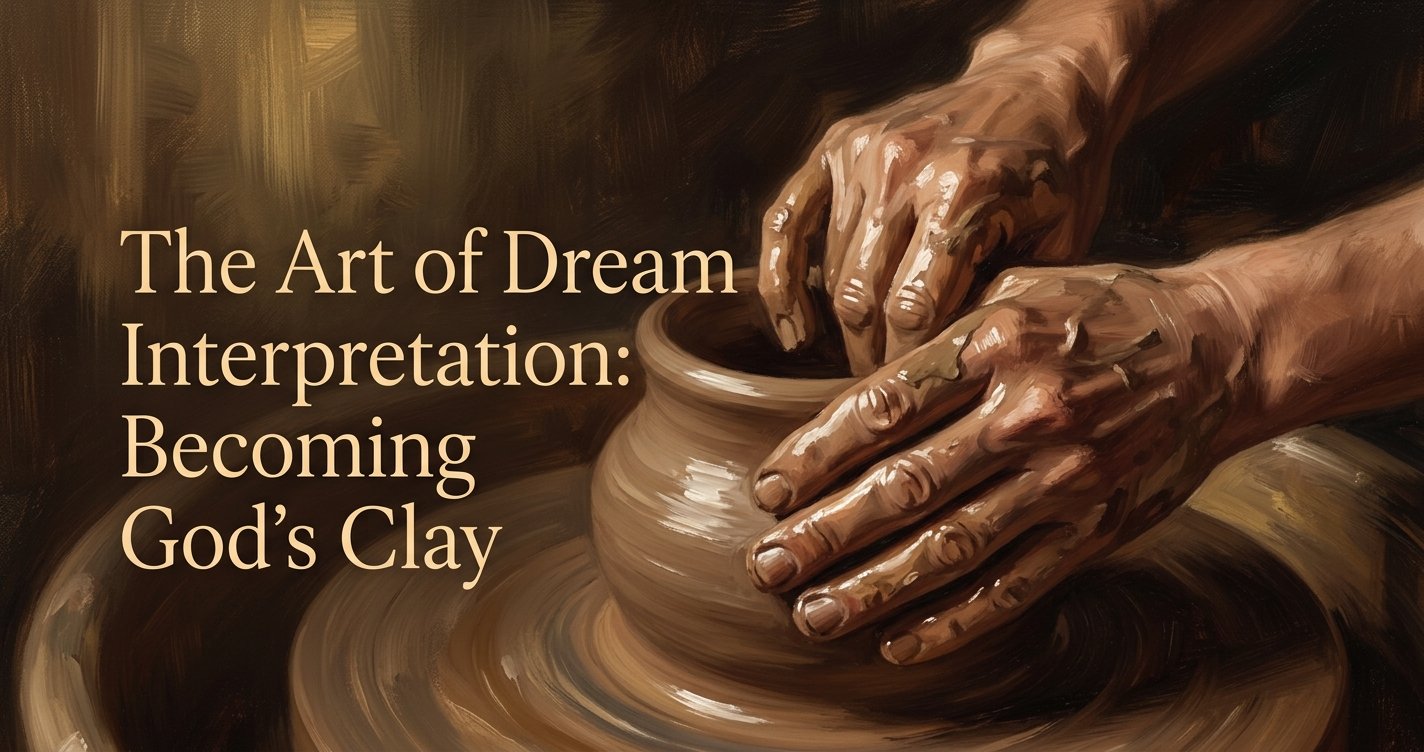
Picture a lump of clay on a potter's wheel, and the moment the potter's thumbs press into the center of it. That is not a gentle moment. From the clay's side of things, it would feel like being opened up against your will, in the exact center of yourself, by hands you cannot see. That is what a dream from God often feels like on the morning you receive it. Today I want to tell you why that pressure is the kindest thing happening to you.
There is a page in one of my old journals that I have re-read maybe six or seven times over fifteen years. Same dream. Same handwriting, the ink getting fainter every time I came back to it. A semi-truck, crashing in the road right in front of me. Every few years I'd pull that journal out, sit down with whatever wisdom I'd picked up since the last attempt, and get absolutely nothing. Here's what I misunderstood for fifteen years. The interpretation was never late. I was early.
Intro (0:40-2:00)
I'm Angela Meer, and I welcome you into the sacred meeting place of psychology and theology, where the timeless patterns of Scripture meet the deep symbols of the soul. This is The Christian Jung Podcast.
We are in week nine of our ten week series on the dreaming life, and today we finally arrive at interpretation. Now, I know that word makes some of you nervous, and I want to say why before we go one step further. For a lot of Christians, dream interpretation sounds like a dream dictionary you buy at a checkout counter, or like something that belongs to a psychic hotline rather than to the church. I understand that completely. But what we're doing today is the opposite of a dictionary. A dictionary hands you a fixed meaning with no relationship attached. What I'm going to describe is a partnership, with the Holy Spirit, who knows both the dream and the dreamer, and who decides when you're actually ready for what it says.
It's time to awaken holy wonder.
Season Note (2:00-2:45)
One quick thing before we get into it, because a few of you have asked. This is episode nineteen of the season. I only record twenty podcasts a year. That's a deliberate choice, not a scheduling accident, because I would rather give you twenty episodes that are genuinely worth your time than fifty that are filler. But it does mean that if you want to stay connected with me between seasons, the podcast is not where that happens. Two places it does: find me on Substack, just search The Christian Jung, or come to AngelaMeer.com and pick up one of my free resources, which puts you on my email list. I'll say it again at the end, but I wanted you to hear it early in case you don't make it to the last minute of the episode.
Personal Relevance (2:45-11:00)
So let me tell you about that dream.
I once had a dream that took fifteen years to interpret and twenty years to come true. And I was prolific enough as a dreamer and as an interpreter, even back then, to recognize immediately what I had received. There are different kinds of dreams, and this one carried a weight I had already learned to recognize. It was bigger on waking than most dreams are. The symbols felt significant in a way that actively resisted a quick explanation. And it carried that unmistakable sense that this was not about last week, or about the thing I'd been worrying over. It was about the next long season of my life. I call those life dreams. Not all dreams are created equal, and this one was giving me instructions for a future I could not yet see.
And I could not interpret it.
I want you to sit with how humbling that was for someone who teaches this. I took that dream to every trusted counselor I had. People who knew me well. People who knew the Scriptures. People who knew something real about dreams and spiritual discernment. A lot of people took a swing at it. And nothing anyone offered, including everything I came up with myself, ever fit. There is a particular feeling of rightness when an interpretation is correct, and anyone who has worked with dreams for any length of time knows exactly the feeling I'm describing. Something settles. Something clicks into place and stays there. I kept waiting for that feeling. It never came.
So every few years I would pull out the journal and re-read it. I'd try my hand at it again with whatever additional life experience and spiritual depth I'd accumulated since the last attempt. And nothing. Fifteen years of that dream sitting in a journal, interpreted by no one.
Then, about five years ago, something started happening in the wider church. People were being exposed. Frauds in their private lives who were standing in pulpits that same Sunday morning. And that exposure movement is still going, and it is not slowing down. But it wasn't until it began that my dream started to take shape, because the major event in my dream was a semi-truck crashing in the road in front of me. And right in the middle of watching those church exposures unfold, that image came rushing back to me. All at once, the entire dream became interpretable. Not because I had gotten smarter. Only because the events of the world had finally caught up to my dream.
Here's what it turned out to be saying. By exposing some major structural problems in the western church, God was showing me that I would rise above a calamitous time in the church, and that my own ministry, helping people develop a psychologically whole Christianity, was going to flourish right in the middle of those exposures. It really was a life dream. It explained, in retrospect, why all the challenges of my ministry had been exactly what they were. All of it had been preparing me to be available to a psychologically fractured church.
And I'll tell you where I was standing when it all landed. I was in the middle of writing a blog article. Not in a prayer meeting. Not on a retreat. Not fasting on a mountainside. Writing a blog post at my desk on an ordinary day. So don't underestimate when or where the Holy Spirit decides to illuminate a dream for you.
I want to be honest with you about what those fifteen years actually felt like, because I think the tidy version of this story would cheat you. There were stretches where I wondered whether I'd misread the whole thing. Whether I'd inflated an ordinary dream into a life dream because I wanted my life to have that kind of significance. That's a real temptation and I don't want to pretend I floated above it. There were also seasons where I was frankly annoyed, where I'd pull out the journal, read the thing again, and think, all right, Lord, this has been sitting here for a decade now, and You have not said one word about it. I said that to Him more than once, and not always gently.
What I could not have known, and what I only see clearly in hindsight, is that I would not have been able to receive that interpretation any earlier than I did. Not because God was being coy, but because the meaning of that dream required me to have already walked through certain things in ministry that hadn't happened yet in year three, or year eight, or year twelve. The dream was describing a role I had not yet been formed enough to step into. Handing me the meaning early would have handed it to a version of me who could not have carried it.
Define the Concept: Why Interpretation Comes Last (11:00-18:00)
Here's something a few of you may have noticed about this series, and some of you are noticing only now that I'm saying it out loud. I built the entire foundation of dream interpretation before I ever taught interpretation itself. Nine weeks of it. That was completely deliberate.
I've been teaching this material for more than twenty-five years, and the thing I understand now that I did not understand early on is that interpretation is the last step of the process. Not the first. In weeks one and two we established the Biblical ground and the early church's practice, and why we stopped doing this and what that disconnection cost us. In weeks three through eight we built the actual skills: recognizing and responding to the emotions inside a dream, excavating symbols, discernment practices, and how a person is spiritually formed through their dream life at all.
And here's the reason that order matters so much. Interpretation, at its most basic level, is not something you do. It is something the Holy Spirit does. If you partner with Him in the foundation, the way we've been practicing for eight weeks, then He can build on your obvious desire to hear Him. He interprets these dreams with you and for you. That is categorically different from interpreting them yourself with a dream dictionary or a technique that relies entirely on human skill. One of those is a relationship. The other is a lookup table.
There's a second reason the foundation matters, and my fifteen-year dream is the proof of it. When the Holy Spirit waits, and sometimes He waits a very long time, the foundation is what keeps you in the conversation during the waiting. If all I'd had was a technique, I'd have abandoned that dream by year three. The technique failed. What kept me returning to that journal every few years was a relationship with Someone I trusted to eventually speak.
And I want to name the specific danger of getting this order backwards, because I've watched it hurt people. When you go after interpretation first, without the foundation and without the relationship, you will get an answer. That's the problem. You will always get an answer, because the human mind is exceptionally good at producing meaning on demand. What you won't have is any way to test whether the answer is His or yours. I had well-meaning people hand me interpretations of my semi-truck dream that were confident, articulate, biblically decorated, and completely wrong. Confidence is not confirmation. That settled feeling of rightness I keep describing is not something you can manufacture by trying harder, and learning to wait for it rather than counterfeit it is most of the skill.
Real Jung, and Yale (18:00-24:00)
I want to bring Carl Jung in here, because he documented something about this that I find genuinely striking.
In Psychology and Religion, which came out of lectures he delivered at Yale University in 1937, Jung used the dreams of patients who were atheists to demonstrate to his audience that even people who denied God entirely were being formed by something at night. He describes one patient in particular who kept encountering what Jung called a religious voice in his dreams, a voice completely at odds with the scientific method this man lived by during his waking hours. And eventually that man had to admit to Jung that his dreams carried a holy nature. He could not explain it within his own framework, and he could not deny the quality of what he was receiving.
Now, I want to be careful here in the way I always am. Jung is not the authority on your dream life, and he was not making a theological claim about who was speaking to that man. But the observation stands, and it is remarkable: a committed atheist, examined by a secular psychiatrist, reporting a holy voice arriving in sleep that contradicted everything he consciously believed. Jung had no category that could fully account for that. We do.
And I want you to hold that next to something happening right now. In the Middle East, Muslims are coming to Christ in droves, and a great deal of it is happening through dreams. God is evangelizing people while they sleep. He is reaching past every waking barrier, every cultural gate, every argument a person would have been ready to make in daylight, and He is doing it in the one room where our defenses are down. If He will do that to bring a stranger to Himself, why would we assume He is doing nothing with the dreams of His own sons and daughters?
That's the whole premise of today. Dreaming is one of the ways God shapes the soul for the work of ministry He has called us to. It is not decoration on the side of a spiritual life. It is formation happening in a room most of us have never thought to enter on purpose.
Anchor in Scripture: The Helper, the Ramparts, and the Wheel (24:00-32:00)
Let's put Scripture next to all of this, because none of what I've described about my own dream is unusual. It's the pattern the Bible already gives us.
John 14:26 says, the Helper, the Holy Spirit, whom the Father will send in my name, he will teach you all things and bring to your remembrance all that I have said to you. Look at how precisely that describes what happened to me. First, He reminded me of the dream. And for some of you, that may mean He reminds you of a dream you'd completely forgotten by the time you got your coffee. Have you ever had a dream come rushing back to you in the middle of an ordinary afternoon, unbidden? That is Him. Second, He showed me the symbol in the light of current events, in a flash of insight I could not have engineered. I was able to hold the world's events and my dream's central image side by side, and they illuminated each other far beyond what I could have managed alone. And third, once that one central image was interpreted correctly, the rest of the dream made an enormous amount of sense. That's a practical principle worth keeping: get the major activity of the dream interpreted first, and the rest tends to fall into place behind it.
Then Habakkuk 2, which has become my anchor for every dream that refuses to open. I will stand at my watch and station myself on the ramparts, I will look to see what he will say to me. And then the Lord's own answer: the revelation awaits an appointed time, it speaks of the end and will not prove false. Though it lingers, wait for it. It will certainly come and will not delay. I want you to hear how strange and how kind that is. God is not saying the revelation is running behind schedule. He's saying it has an appointed time that is not the same as your preferred time. Standing on the ramparts is not passivity, and it is not spiritual stalling. It is the posture of someone who has done the foundational work and is now waiting with the journal open.
And then the passages that give today its title. Isaiah 64:8: yet you, Lord, are our Father, we are the clay, you are the potter, we are all the work of your hand. Jeremiah 18, where God sends the prophet down to the potter's house to watch a malformed pot get reshaped on the wheel, and then says, can I not do with you as this potter does, like clay in the hand of the potter, so are you in my hand. Isaiah 45:9, a warning to the one who quarrels with their Maker, asking whether the clay says to the potter, what are you making. And Job 10:9, remember that you molded me like clay, will you now turn me back to dust.
Four passages, one insistence. Scripture will not stop calling us clay. And Romans 8 tells us why: He is maturing us into sons and daughters. Leaning into Him for spiritual insight, dreams included, is how we let His life flow through us instead of operating out of our own strength, our own intelligence, our own memorized catalogue of dream imagery.
I want to stay in Jeremiah 18 one more minute, because the detail most people skip is the one that matters most. The pot Jeremiah watches is marred. It goes wrong on the wheel. And the potter does not throw it out, and he does not start over with different clay. He reshapes the same clay into another vessel, as it seemed good to him to do. That is the picture God chooses for Himself when He wants to explain His relationship to a people who had gone badly wrong. Not a potter who discards. A potter who reworks. If you have ever woken up from a dream that showed you something genuinely unflattering about yourself, some pride or self-protection or hunger for approval you'd rather not have seen, that is the passage to read on the way to breakfast. The showing is not the discarding. The showing is His hands going back onto the same clay.
Mid-Episode Invitation (around 32:00)
If you've been carrying a dream you've never been able to interpret, come find me. Go to Substack and search for The Christian Jung. That's where this week's free article lives, along with The Inner Room, our paid tier, where we take these foundations and work them as an actual self-examination instead of a checklist. And if you want a full roadmap for using your dreams to deepen your walk with God, my course waitlist is open at AngelaMeer.com.
Three Teaching Points (32:00-39:00)
Today's Three Movements of Interpretation:
• Interpretation is the last step, not the first. It rests on foundations: emotional beats over plot points, symbols tracked into waking life, discernment, the habit of writing dreams down. Skip the foundations and you will interpret with a dictionary instead of with a Person, and the dictionary cannot tell when you're ready.
• A dream that lingers is not a dream that failed. Mine sat unread and unsolved for fifteen years, through every counselor I trusted, until the world caught up to its central image. Habakkuk already told us the revelation awaits an appointed time. If your dream hasn't opened, the likeliest explanation is not that you're bad at this. It's that you're standing earlier in the story than the meaning is.
• Interpretation is not the goal. Formation is. Dream work is really about recognizing the areas of distance God is trying to close between you and Him. That means dreams will often show you where pride or self-serving attitudes are operating in you, and receiving that takes real maturity and patience with yourself. Letting Him be the potter is the whole point. The interpretation is just how you find out where His thumbs are pressing.
One Practical Step Before You Sleep Tonight (39:00-44:00)
Here's your practical work this week, and it's a review rather than a new technique, because the review is the point.
Take one dream you've been carrying, and run it through the seven foundations we've built across this series. First, write the emotional beats rather than the plot points. What did you feel, in order, more than what happened, in order. Second, ask where symbols from that dream are also appearing in your waking life right now. Third, ask what the feelings of the dream are pointing toward in terms of inner work, and be willing for the answer to be an action rather than an interpretation. I want to underline that one. That is where the good stuff of the abundant life in Christ actually lives, and most people blow right past it in a hurry to get a meaning.
Fourth, ask what work each symbol is doing. What does it feel like, what associations does it carry, what factual details can you dig up about it. Fifth, ask what Bible stories or verses the dream touches. Sixth, ask how you've discerned it, and be honest about whether you're dismissing it simply because its feeling-tone turns you off. And seventh, ask who showed up in the dream and why they, specifically, were the one to appear.
Then ask the posture question underneath all seven, which is really the question of the whole episode. Where am I an obstacle to my own growth right now? Where is God trying to close distance between us that I've been maintaining? Sit with that before you reach for any meaning at all. If nothing opens this week, close the journal and come back in six months. I promise you that is a legitimate outcome and not a failure. Ask me how I know.
One more thing about the seven, and then I'll let you go work. Don't try to run all of them on the same dream in one sitting. I've watched people turn this into a worksheet, grind through every question in forty-five minutes, and come out the other side with a very organized page and absolutely no encounter. That's the intellect doing what the intellect does, which is manage the material so it doesn't have to be moved by it. Take one question. Sit with it for a day. Let it work on you between the errands and the email. The foundations were never meant to be a form you complete. They are seven different doors into the same room, and you only need to walk through one of them at a time for God to meet you there.
Recap (44:00-46:00)
So today we finally arrived at interpretation, after nine weeks of foundation, and I told you why I built it in that order. We talked about the dream that took me fifteen years to interpret and twenty years to come true, the semi-truck crashing in the road, every counselor who tried and couldn't crack it, and the flash of insight that came only when the church exposure movement caught the world up to my dream. We looked at John 14:26 and the three things the Holy Spirit did: reminding, illuminating in the light of current events, and opening the rest of the dream once the central image was right. We stood on Habakkuk's ramparts and heard that the revelation awaits an appointed time. We walked through Isaiah 64, Jeremiah 18, Isaiah 45, and Job 10, where Scripture will not stop calling us clay. And we looked at Carl Jung's atheist patients at Yale in 1937, and at the Muslims coming to Christ through dreams right now, because God has never needed our permission to speak at night.
Pause, Pray, Heal (46:00-48:30)
Let's end this time with a moment to pause, pray, and heal. Take a deep breath, and rest into what you've received today.
Pause: Where is God shaping you through your dreams right now? Sit with that for a moment, and let Him have access to the clay of your psyche once again.
Pray: this is a hymn of surrender written in 1907 by Adelaide Pollard. She was discouraged at the time, unable to raise the funds for a mission trip to Africa she believed God had called her to, and she wrote it after overhearing an older woman at a prayer meeting pray that it didn't matter what God did with them, as long as He had His way. [Read stanza one here.]
Heal: Sit with this image. You are clay on God's pottering wheel. Where is He working on you? Where is He strengthening your weak areas? Where is He trimming away the parts you no longer need? And where are the beautiful areas, the places already taking their shape?
A Closing Thought on Waiting (48:30-49:30)
Before we close, I want to speak to whoever is sitting there thinking about a dream they gave up on. Maybe years ago. Maybe you decided you'd gotten it wrong, or that it never meant anything, or that you weren't the kind of person God speaks to that way. I had fifteen years of exactly that feeling with one page in one journal. What I know now is that the silence was never God withholding. It was God waiting for the world, and for me, to arrive at the place where the dream could actually be understood. Go find that page again. You may be standing in a very different part of the story now than you were the last time you read it.
Final (49:30-51:00)
This has been episode nineteen of the season, and as I mentioned at the top, I only record twenty podcasts a year. That's on purpose. I would rather give you twenty episodes worth your time than a pile of filler. But it does mean the podcast goes quiet between seasons, so if you want to keep walking with me in the meantime, here are the two best ways. Find me on Substack, just search The Christian Jung, and you'll get every article in your inbox and in the app. Or come to AngelaMeer.com and pick up one of my free resources, which puts you on my email list so you'll know the moment the next season and the next course open up.
Next week is week ten, the last one in this dreams series, and we finish what we started. Share this episode with someone who has a dream they've never been able to make sense of, and find me at angelameer.com or on Substack as The Christian Jung.
Awaken Holy Wonder.