

E.2-20: Dreams as a Practice in Art: How Dreams and Art Both Awaken Your Soul to Jesus
Season 2: Episode 20
Dreams as a Practice in Art: How Dreams and Art Both Awaken Your Soul to Jesus
listen by clicking the audio player here:
In this episode you will learn:
The article is about
• AI can outsmart us on Scripture, exegesis, and archaeology. It cannot dream. Dreaming is a personalized language between you and God that technology will never touch.
• Writing a dream down is already translating it out of symbol and into English, and translation always loses something. Drawing it keeps you in the original language.
• Jung kept an illustrated dream journal because his rational brain was only extracting intellectual meaning, never the meaning of the soul.
Episode Length: 29:00
can’t get enough? sign up for free 5-day email series here

Transcript
A year ago I was sitting with a book of Carl Jung's mandalas open in front of me, and the Lord said something I did not want to hear. Stop writing your dreams down. Start drawing them. I have kept a written dream journal for twenty-five years. I was good at it. And what I did not understand until that moment was that every single time I wrote a dream down, I had been translating it out of the language it arrived in.
Intro (0:40-2:00)
I'm Angela Meer, and I welcome you into the sacred meeting place of psychology and theology, where the timeless patterns of Scripture meet the deep symbols of the soul. This is The Christian Jung Podcast.
This is week ten of our ten week series on the dreaming life, which means we finish today. And we finish in a place that might sound like a detour if you have been with me from the beginning. We are going to talk about art. Now, I know that for some of you the word art immediately files this under nice-if-you-have-time, somewhere beneath the real spiritual disciplines. Prayer, Scripture, fasting, and then somewhere much further down the list, crafts. I understand that instinct. What I want to show you today is that making something with your hands is not a lesser cousin of the disciplines. For the dreaming life specifically, it may be the most direct access you have, because it is the only practice that speaks the same language your dreams already speak.
It's time to awaken holy wonder.
Season Note (2:00-2:45)
One thing before we start, because it matters today more than usual. This is episode twenty of the season, and twenty is all I record in a year. That is a deliberate choice. I would rather give you twenty episodes worth your time than fifty that are filler. But it does mean that after today, the podcast goes quiet for a while. So if this series has been doing something in you and you want to keep going, do not wait until you notice the silence. Find me on Substack, just search The Christian Jung, where the writing continues every single week. Or go to AngelaMeer.com and pick up one of the free resources, which puts you on my email list so you will know the moment the next season opens. I will say all of this again at the end, but I would rather tell you now than lose you to a quiet feed.
Personal Relevance (2:45-11:30)
So let me tell you what happened a year ago, and to do that I have to tell you how I used to work.
When I first started tracking my dreams twenty-five years ago, I was extremely detailed, and I dreamt prolifically. It was odd if I was not up several times a night writing dreams down in painstaking detail, like I was transcribing the plot of a movie. And for those of you who have followed this whole series, you know that is no longer how I tell anyone to do it. Partly because a practice like that is not sustainable. But mostly because it was rooted in fear. There was a fear underneath all that diligence that went like this: if I miss one dream, I miss its message, I miss the importance of it, I miss what God wanted me to know. That is fear-rooted perfectionism wearing the costume of devotion, and I do not want to strengthen that in you.
So over the years I moved to something lighter. I would track the emotional tones. The major symbolic moments. The big action of the dream. And usually only after coffee, which I mention because people are always surprised by it. When I first wake up, before coffee, I tend to analyze a dream away. It is not until I have had that cup that I am actually in the headspace to honor the message rather than immediately explain it. You may be completely different. You do you.
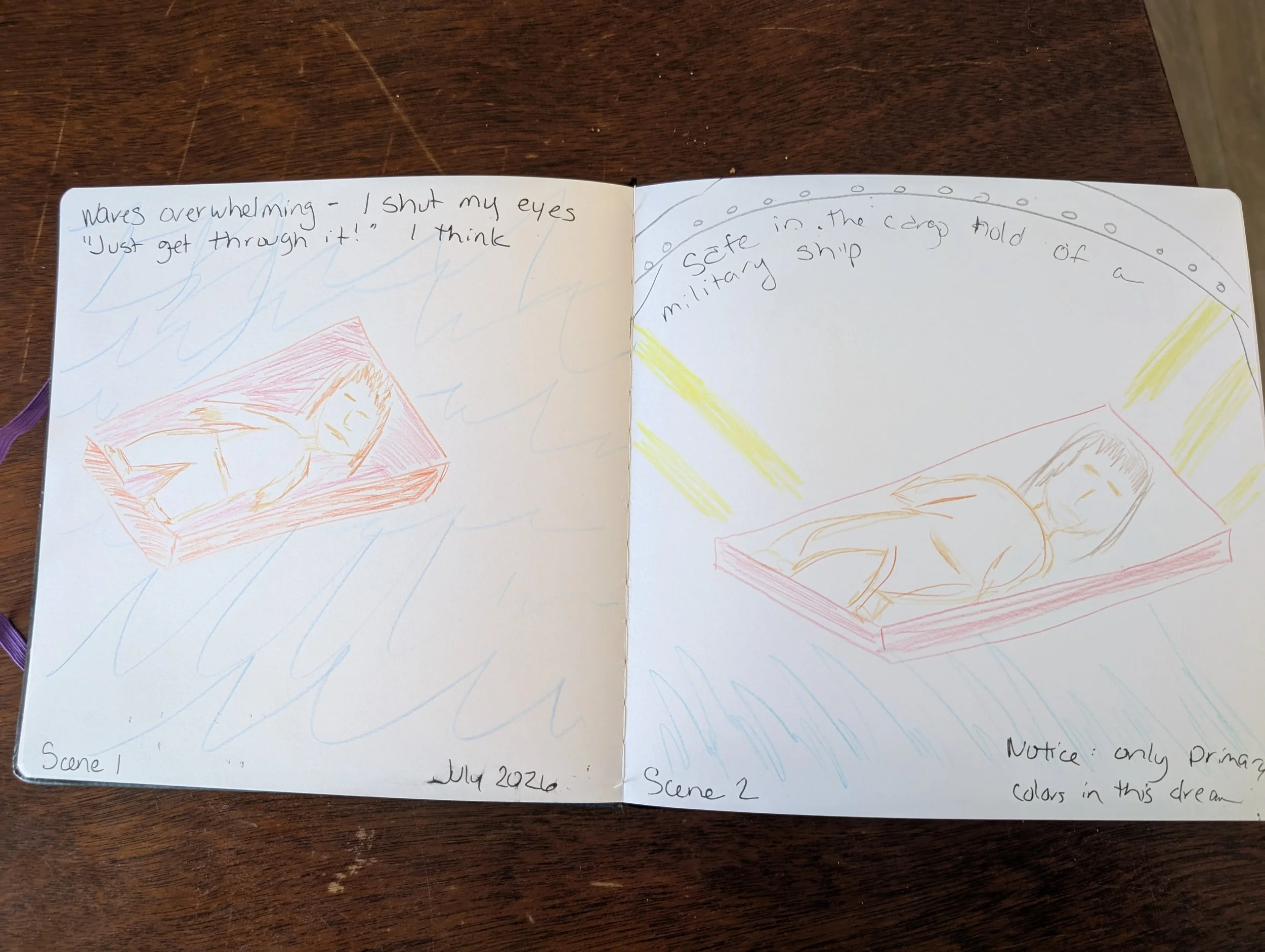
Then last year, everything changed. I was studying Carl Jung's mandalas, which are the circular drawings he made almost daily as a way of recording the state of his soul, and the Lord spoke to me. He told me it was time to start illustrating my dreams instead of writing them down as a journal entry.
And I am going to be honest with you about my response, because I think the tidy version would be useless to you. I was not thrilled. I do create art, and I love it, but I am rarely in the headspace for it, maybe once or twice a year. So my objections came fast. I do not have time for this. I can barely keep up with journaling as it is. And underneath those, quieter and more honest: I am not sure I am good enough at it for this to be worth doing.
I want you to notice something about that last objection, because I think it is the one most of you are carrying too. It assumes an audience. It assumes someone is going to look at the drawing and evaluate it. But there is no audience. There never was. This is not art for a gallery. It is art as a language, and a language does not have to be beautiful in order to be accurate.
The time objection deserves an honest answer too, because it is true. Drawing a dream is slower than writing one. Considerably slower. Writing a dream down takes me four minutes and leaves me feeling appropriately spiritual and efficiently finished. Drawing the same dream takes twenty, and somewhere around minute eleven I find myself stuck on a question I would never otherwise have asked. That slowness is not the cost of the practice. It is the practice. The twenty minutes are not four minutes of journaling plus sixteen minutes of inefficiency. They are sixteen minutes of the kind of attention that a written entry structurally cannot produce.
And I will tell you what actually happened once I started, because I want you to have a realistic picture rather than a testimonial. The first several were bad. Genuinely bad, in the way a thing is bad when you have not done it in a while and your hands have opinions your intentions do not share. But here is what surprised me: it did not matter at all. The badness was completely irrelevant to what the practice was doing in me. I have never once looked back at an illustrated entry and thought, I wish that were better. I have looked back many times and thought, I had forgotten that the water was that particular green, and I wonder why.
Define the Concept: You Have Been Translating This Whole Time (11:30-19:00)
Here is the thing I did not see for twenty-five years, and it is the center of everything I want to give you today.
When I wrote a dream down, I was already translating it. The dream arrived in symbols. I converted it into English sentences. And I did that conversion before I had begun to understand what the dream was saying, which means every act of interpretation I performed after that was being done on a translation rather than on the original.
And translation always loses some essence of meaning. This is not a controversial claim in any other part of our faith. It is exactly why theologians train in Greek and Hebrew rather than settling for a good English Bible. Something lives in the original language that the best translation in the world cannot fully carry across. We accept that completely when it comes to Scripture. We just never thought to apply it to the thing God is saying to us at night.
Think back to weeks one and two of this series. God uses symbols to convey information. He does it in Scripture, He does it in parables, He does it in dreams, and He does it on purpose. Symbols are not fixed. They transform. They mean different things to different people, which is precisely why He chooses them. A symbol builds a personal relationship with Jesus in a way a proposition cannot, and here is the strange part: it does that partly by not being fully understandable. The not-understanding is not a bug in the system. It keeps you coming back to Him rather than filing the matter closed.
So when I recreate a symbol instead of describing it, I am staying inside the same vehicle of language the dream came in. And that changes the questions I ask. These are real questions from my own illustrated journal. Does that color truly represent the image I saw, or did I just reach for the closest pencil? Why are there so many upward spatial planes in my dreams recently, and when did that start? Does this symbol, a mirror, actually look like this other thing, a spoon, and could that resemblance be telling me something?
Not one of those questions would have surfaced in a written journal. Not one. They are only available to someone who stayed in the symbol long enough to have to make decisions about it.
Real Jung: The Man Who Needed Art to Find His Own Soul (19:00-26:00)
Carl Jung is the first person I know of in the modern era to keep an illustrated dream journal, and the story of why he started is worth your time.
Jung worked in watercolor and oil. He did calligraphy. He worked in stone. He worked in architecture, and built things with his own hands. I once read a review of his artwork claiming he could have been received as a significant artist of his era if he had allowed the art world to take him that way, instead of insisting on being received as a psychologist. But he never saw himself as an artist. He saw himself as a man who needed art in order to understand his own soul. Those are completely different motivations, and the second one is available to you whether or not you can draw.
Here is why he started. Jung realized his rational brain was extracting only intellectual meaning from his inner life, and never the meaning of the soul. Sit with that for a second, because I think it is one of the most quietly convicting sentences in this entire series. His rational mind was not failing. It was working beautifully. It was producing insight, analysis, category, explanation. And all of it was landing at the level of the intellect and going no further down.
How often are we doing exactly that? Reinforcing our intellect, over and over, and calling it spiritual growth, while the soul stands off to the side waiting to be addressed in a language it actually speaks?
There is a particular moment in Jung's life I love. At Bollingen, the tower he built for himself on Lake Zurich, he started one day building a small castle out of materials lying around on the ground, exactly the way he had built things as a child. And he became completely immersed in it. Not analyzing, not theorizing, just building. And in that immersion he began connecting dots and making meaning in places he had not expected and could not have reached by thinking harder. Play became an integral part of his working method from then on.
I would argue play is integral for anyone who needs to disconnect from the rational world long enough to hear what God is saying to their soul. Which, if we are honest, is most of us, most of the time.
Anchor in Scripture: The Bereans, the Image, and the Thing AI Cannot Do (26:00-33:00)
I want to bring this into Scripture, and I want to start somewhere that might surprise you, with artificial intelligence.
I am not going to pretend to be neutral here, so let me tell you where I am standing. My bachelor's degree is in Emerging Media. Both of my master's degrees are in Jungian Depth Psychology. So I am positioned to look at this from two directions at once, critically as a depth psychologist and hopefully as someone trained in emerging media. And there is a third thing. My husband and I both rely on technology because of disability and health issues. I have Cerebral Palsy. He has type 1 diabetes. That interdependence between human biology and technology is only going to increase over the years, in my house and in yours. So when I talk about AI, I am not talking about it from a safe distance.
Here is what we all need to understand. AI can already outsmart us on the Bible, on methodologies, on theories of exegesis, on historical and archaeological findings, and in many other areas. And here is the interesting reason why. It is because we have been excellent Bereans. Acts 17 tells us the people of Berea received the word with eagerness and examined the Scriptures daily to see whether these things were so. We have done that for two thousand years, and in the last thirty we filled the internet with the fruit of it, article after article of careful study. AI learned from that. In a strange way, its competence with Scripture is a monument to our diligence.
But AI cannot dream.
Maybe one day dreaming will be some kind of feature. I am not interested in arguing about that. What I want you to understand is that dreaming is a highly personalized language between you and God, and that is the part of your soul no technology will ever touch. We are dreamers because we are created in the image of God. Some things, like our intelligence, can be co-opted. Our dreams cannot. They are a uniquely protected part of our created nature.
And Romans 8 tells us what they are for. When we engage the dreaming life, we are engaging the soul's attempt to commune with God, or to remember its way back to pre-fall Eden. Dreams open a doorway to the next transformative step your soul needs in order to understand its purpose, which is to be a son or a daughter of God. That is not decoration on the edge of the Christian life. That is the center of it, and it is happening in a room most of us have never thought to enter on purpose.
I want to say one more thing about the Christian tradition we are standing in here, because I do not want anyone to hear this as novelty. When we take up the subject of Christian dreaming, we are stepping into something at least five thousand years old. The early church, in the first couple of centuries after Christ, wrote and taught extensively about dreams: what the discernment practices were, what the categories of dreams were, how to tell one from another. This was not a fringe interest of a few mystics. It was ordinary pastoral instruction. What is novel is not what we have been doing for the last ten weeks. What is novel, historically speaking, is the silence of the last two hundred years, and that silence has a traceable cause in the Enlightenment and its suspicion of anything that could not be measured.
Invitation (around 33:00)
If this series has been opening something in you, come find me. Go to Substack and search for The Christian Jung. That is where this week's free article lives, along with The Inner Room, our paid tier, where we have gone into the early church's discernment practices in real detail so you can build dreaming into your devotional life.
Three Teaching Points (33:00-40:00)
Today's Three Movements of Art and Dreaming:
• You have been translating your dreams, and translation loses something. The dream arrives in symbol. Writing it converts it into words before you have understood it, which means every interpretation after that is performed on a translation. Theologians learn Greek and Hebrew for exactly this reason. Your dreams deserve the same respect for their original language.
• The intellect is not the problem. Its reach is. Jung turned to art because his rational mind was extracting only intellectual meaning and never soul meaning, and his rational mind was excellent. Yours probably is too. Making something with your hands is not anti-intellectual. It is simply the tool that reaches a floor the intellect cannot get down to.
• AI cannot dream, and that tells you what dreaming is for. Intelligence can be co-opted. Dreams cannot, because they are a personalized language between you and God rooted in the fact that you bear His image. In an age where so much of our thinking can be outsourced, the dreaming life is one of the few places left that is unmistakably, irreducibly yours.
One Practical Step Before You Sleep Tonight (40:00-45:00)
Here is what I want you to do this week, and I have made it as small as I can so that nobody listening has an excuse.
Take one dream. Not a new one necessarily, an old one from your journal is completely fine. Pick the single strongest image in it. Not the plot, one image. Then draw it. Badly. On whatever paper is nearby, with whatever pen is nearby. Give it ten minutes.
And while you draw, pay attention to the decisions you are forced to make, because the decisions are where the work happens. What color was it actually? Is it in the center of the page or off to one side, and which one is true to the dream? How big is it in relation to everything else? Is it closer to you or further away? Every one of those questions is a question about the dream that your written journal never made you answer, and you will find yourself knowing things you did not know you knew.
If you genuinely cannot draw, and I mean that seriously, some of you cannot for reasons that have nothing to do with willingness, then stay artistic by another route. One of our students recreated the castle of her heart using AI, and whole dimensions of understanding opened up for her in places she was not expecting. No art skills required. Collage works. Arranging objects on a table works. Clay works. The skill was never the point. Staying inside the symbol long enough for it to speak to you, that is the point.
And hear me on this: I would rather you journal your dreams somehow than not at all. Words will flatten the depth of your dream life, and illustrating them will invigorate it, but a flattened record beats no record every time. Start where you actually are.
One more caution, and it comes straight out of my own twenty-five years of getting this wrong. Do not let this become another rule. If you take what I have said today and turn it into a nightly obligation that you will feel guilty about breaking by Thursday, you have simply moved the fear-rooted perfectionism from one practice to another and changed nothing. The whole reason I stopped waking up four times a night to transcribe movie plots was that the diligence had become the point, and God was no longer anywhere near the center of it. So draw one image this week. One. If a second one wants to happen, let it. If it does not, you have still done the thing I actually asked.
Recap (45:00-47:00)
So today we closed the series with art. We talked about the year I spent writing dreams down in painstaking detail out of a fear that missing one meant missing God, and why I do not teach it that way anymore. We talked about the moment the Lord interrupted my study of Jung's mandalas and told me to draw my dreams instead of writing them, and how unenthusiastic I was about that. We named the thing I had missed for twenty-five years, that writing a dream down is already a translation, and that translation always costs something, which is why theologians train in the original languages. We looked at Jung, who worked in watercolor and oil and stone and never called himself an artist, only a man who needed art to understand his soul, and at Bollingen, where building a child's castle out of materials on the ground opened meaning that thinking harder never could. And we talked about the Bereans, and about the one thing artificial intelligence cannot do.
Pause, Pray, Heal (47:00-49:30)
Let's end this time, and this season, with a moment to pause, pray, and heal. Take a deep breath, and rest into what you have received, not just today but across these ten weeks.
Pause: think of one image from one dream that has stayed with you through this series. Do not interpret it. Just hold it, and notice what it does when you give it your full attention without demanding anything from it.
Pray: this is the Suscipe, the prayer St. Ignatius of Loyola placed at the close of his Spiritual Exercises in the sixteenth century. I chose it for today because of one word in the middle of it, and I think you will hear which one.
Take, Lord, and receive all my liberty, my memory, my understanding, and my entire will, all that I have and possess. Thou hast given all to me. To Thee, O Lord, I return it. All is Thine, dispose of it wholly according to Thy will. Give me Thy love and Thy grace, for this is sufficient for me.
My understanding. That is the word. Ignatius hands God his liberty, his memory, his will, and right in the middle of that list, his understanding. The very faculty we most want to keep hold of when a dream refuses to make sense. Give that one to Him too.
Heal: this week, take one image and make something with it. Ten minutes, poor materials, no audience. Then bring whatever you made back to God and ask Him what He wants to show you in it.
A Return to Awe (49:30-51:30)
Before I close out the season, I want to tell you what comes next, because a few of you have been asking since week one.
This fall I am opening a course called A Return to Awe. It blends art, theology, and depth psychology into a single practice, so that you finally have a framework for the dream life you have probably been having alone for years. It is built for the Christian who has the doctrine down and still feels like something is missing on Sunday night.
It is an interactive lab, not a lecture series. You will turn a dream's central image into art. There will be journaling prompts, and nature walks, and guided group contemplation done the way the early church fathers did it. And you will get real-time, personal feedback from me on your own dreams. Not a symbol dictionary. A direct response to what God is actually showing you.
Spots are limited, and I want to be clear about why. It is not a sales tactic. It is because this is about community, not about the masses, and because the feedback is personal and there is only one of me.
The early-bird wait list gets first access when doors open, before the general public hears about it. Go to AngelaMeer.com to get on it, or subscribe on Substack and you will hear it there first. It's time to return to awe.
Final (51:30-53:00)
That is episode twenty, and that is the season. Ten weeks on the dreaming life, from the Biblical and early church foundations, through emotional beats and symbol excavation and the cast of figures in your dreams, through repeating signs, through nightmares and discernment, through post-dream formation and interpretation, and now to art. Thank you for staying with the whole thing. Series like this only work because people actually walk them.
And if you came in somewhere in the middle, or if you have been listening to this one episode wondering what the previous nine were doing, everything is still there. The articles do not expire and the episodes do not disappear. Start at week one, where we build the Biblical and historical case, and work forward in order. This material was designed to be sequential, foundation first and interpretation last, and it rewards being taken that way far more than it rewards being sampled.
The podcast goes quiet now until the next season, so here is how to stay with me in the meantime. Find me on Substack, search The Christian Jung, where the writing continues every week. Or go to AngelaMeer.com and pick up one of the free resources, which puts you on my email list so you will know the moment the next season and the Return to Awe doors open. And share this episode with someone who has been dreaming alone.